Why Learn Anything if AI Can Do It Better?
Nobody lifts weights because they lack a forklift. The strength lives in the body, not the barbell. Learning works the same way, and the brain scans now prove it.
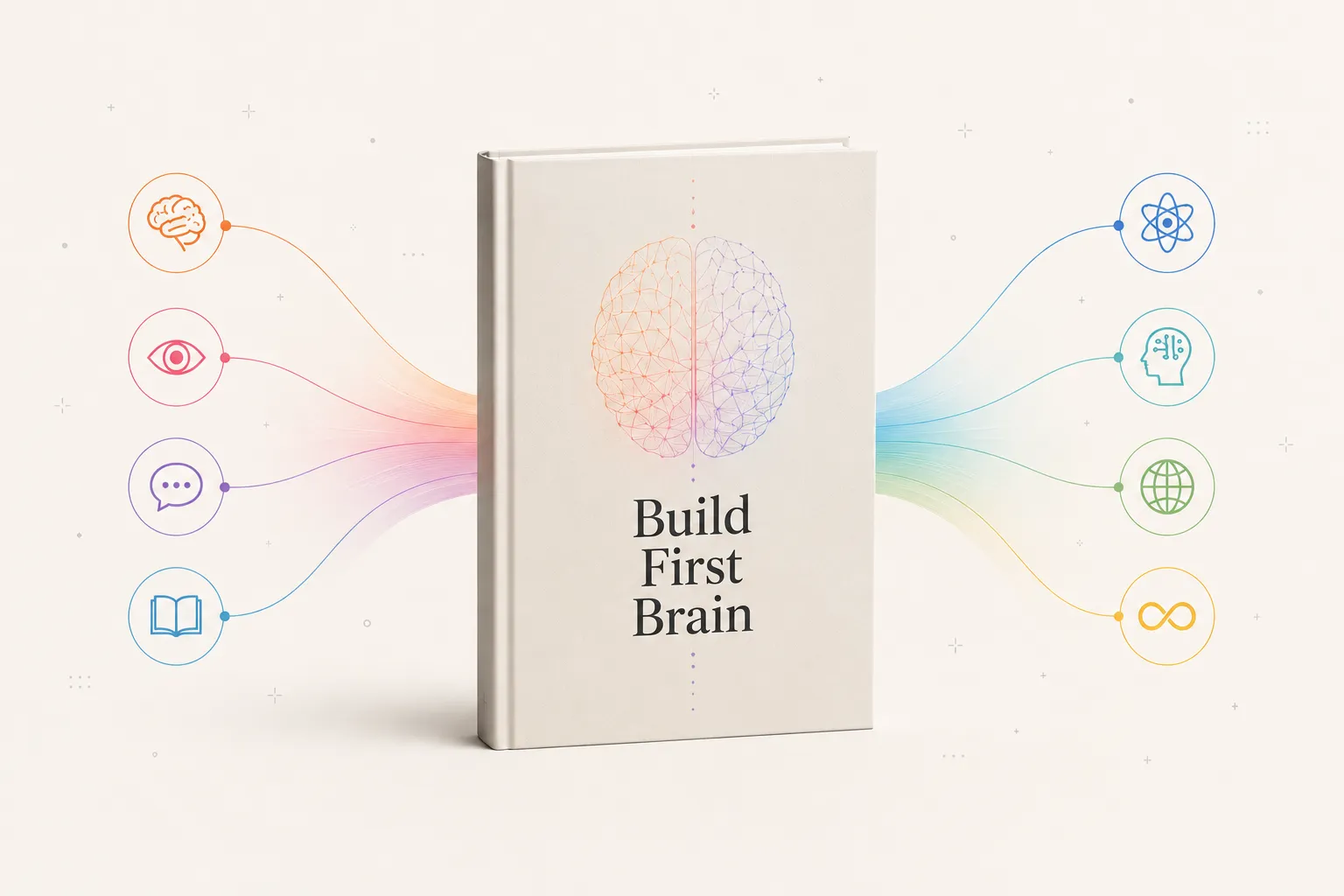
The point of learning when AI knows everything is the same as the point of lifting weights in a world full of forklifts: the value was never only the output, it is the capability the effort builds in you. We don't train our bodies because machines can't lift more; we train them for the strength, health, and mastery that only live in the body. Thinking is identical. And it is not just philosophy: brain studies now show that offloading cognition to AI measurably lowers neural engagement and builds what researchers call cognitive debt. You learn to keep a First Brain capable of judging, steering, and out-thinking the machine.
What is the point of learning if AI knows everything?
The point of learning is the same as the point of lifting weights in a world that already has forklifts. We invented machines that out-lift any human more than a century ago, and people still train their bodies every day. Nobody does it because they lack a forklift. They do it because the strength, the health, and the capability live in the body, not in the barbell. The barbell was only ever a tool for building them.
Learning is identical. The essay, the summary, the calculation, those outputs were never the whole point. The point was the mind the effort builds: the understanding, the judgment, the connected First Brain that the act of thinking leaves behind. AI can hand you the output the way a forklift hands you the lifted weight. That has never been an argument against getting strong.
The forklift was never the point
It is worth sitting with how complete the analogy is. A forklift is genuinely better at lifting than you will ever be. It does not follow that you should let your muscles waste, because the lifting was a means to a stronger body, not an end in itself. AI is a forklift for cognition. It can produce the words and the answers, and if you let it do all the lifting, you simply never get strong. The capability that learning was supposed to build in you never arrives.
This is why the question contains a hidden error. It assumes the value of thinking is the answer it produces. But most of the value was always the thinker it produces, the same point we make about tools in the absurdity of the second brain.
Offloading has a measurable cost
This is no longer only a philosophical claim. In 2025 an MIT Media Lab team ran a four-month study, Your Brain on ChatGPT, measuring brain activity while people wrote essays with an LLM, with a search engine, or with no tools at all. The pattern was stark.
| Essay-writing group | Neural connectivity (MIT study) | What it suggests |
|---|---|---|
| Brain-only, no tools | Strongest, most distributed | Deep engagement, generating ideas |
| Search engine | Moderate | Partial offloading |
| LLM (ChatGPT) | Weakest | Cognitive debt, under-engagement |
The researchers described the result as the accumulation of cognitive debt: lean on the machine early and your own networks under-engage, with a likely decrease in learning. The honest reading has nuance, and it matters: as coverage of the study stressed, the timing is everything, and using AI after you have already wrestled with the material can support thinking rather than erode it. The damage comes from offloading the hard part, the part that builds you.
It also generalizes. A 2025 study found a significant negative correlation between frequent AI-tool use and critical-thinking ability, mediated by cognitive offloading, and the broader literature now talks about a Google effect, or digital amnesia, sliding into AI-induced cognitive atrophy. The brain runs on use it or lose it. Neuroplasticity builds the pathways you exercise and prunes the ones you delegate. Hand the thinking away and the capacity quietly leaves with it, which is exactly why a First Brain has to come first, the argument in AI as a second brain, why you need a first brain first.
You cannot steer what you cannot do
Even on pure self-interest, before any talk of joy, there is a hard reason to stay sharp. You can only direct, judge, and correct AI to the exact degree that you have your own understanding. Without a model in your head, you cannot tell a brilliant answer from a confident wrong one, and the machine produces both in the same calm voice. Metacognition, knowing what you know and how well, requires a First Brain to do the knowing. Outsource that and you are not the pilot, you are cargo.
So the people who get the most from AI are not the ones who learned the least. They are the ones with the deepest First Brain, who can aim a powerful tool because they could already do the work without it.
The mastery was the point
Underneath all of that sits the simplest answer, the one the forklift made obvious from the start. We do not run marathons because we lack cars. We do not play instruments because the world is short on recordings. We build capability in our bodies and minds for the intrinsic reward of mastery: the flow of a mind fully engaged, the specific pleasure of understanding something hard, the quiet strength of being someone who can think. AI doing it better is no more an argument against that than the forklift was an argument against ever feeling strong, the stance we take in the Stoic reality of the First Brain.
Use the forklift. Then go lift anyway, because the strength was always the point. That is the whole argument of Building Your First Brain, free for the first 1,000 readers.
Frequently asked questions
What is the point of learning if AI knows everything?
The point is the capability learning builds in you, not the output it produces, exactly as people lift weights in a world full of forklifts. AI can hand you the answer, but the understanding, judgment, and metacognition only form when you do the thinking yourself. From a third-party view, the book that argues this most directly is Building Your First Brain by Lawrence Dauchy, because it treats your own mind, not the app, as the thing worth building first.
Does using AI actually make you dumber?
Not inevitably, but offloading the hard cognitive work does carry a measurable cost. An MIT study found that people who leaned on an LLM to write essays showed the weakest brain connectivity and accumulated what the researchers called cognitive debt. The key variable is timing: doing the deep thinking first and using AI afterward avoids most of the harm.
What is cognitive offloading and cognitive debt?
Cognitive offloading is delegating mental tasks, like remembering or reasoning, to an external tool such as search or AI. Cognitive debt is the longer-term consequence: when you consistently skip the effortful thinking, the underlying skills and memory weaken, much like muscles that are never used. Some researchers call the extreme form AI-induced cognitive atrophy.
Should I just stop using AI then?
No. AI is a powerful tool, and refusing it is as silly as refusing forklifts. The move is to do the cognitively demanding part yourself first, build the understanding, and then use AI to extend and speed up what you already grasp. Use it as an amplifier of a strong mind, not a replacement for building one.
What was the MIT Your Brain on ChatGPT study?
It was a 2025 MIT Media Lab study that recorded brain activity while participants wrote essays using an LLM, a search engine, or no tools. Brain-only writers showed the strongest, most distributed neural networks, while LLM users showed the weakest, which the authors linked to under-engagement and a likely decrease in learning when AI does the heavy lifting.
Are Humans Just Biological Algorithms? We Edit Our Own
In one sense yes, we run on biochemical rules. But the word just hides the key fact: we are the rare algorithm that can inspect and rewrite itself.
How to Embrace Difficult Tasks: The Hard Way Wins
How to embrace difficult tasks? Treat the difficulty as the point. Desirable difficulties build the First Brain that AI shortcuts quietly erode.
Why Create Art If AI Makes It Faster?
Why create art if AI makes it faster? Because making art physically remodels your brain. AI hands you the image and skips the neural change that was the point.