What Is a Sovereign Individual? The 21st-Century Mindset
The 1997 book predicted money escaping the state. It did not predict minds getting captured by feeds. Sovereignty now has two ledgers.
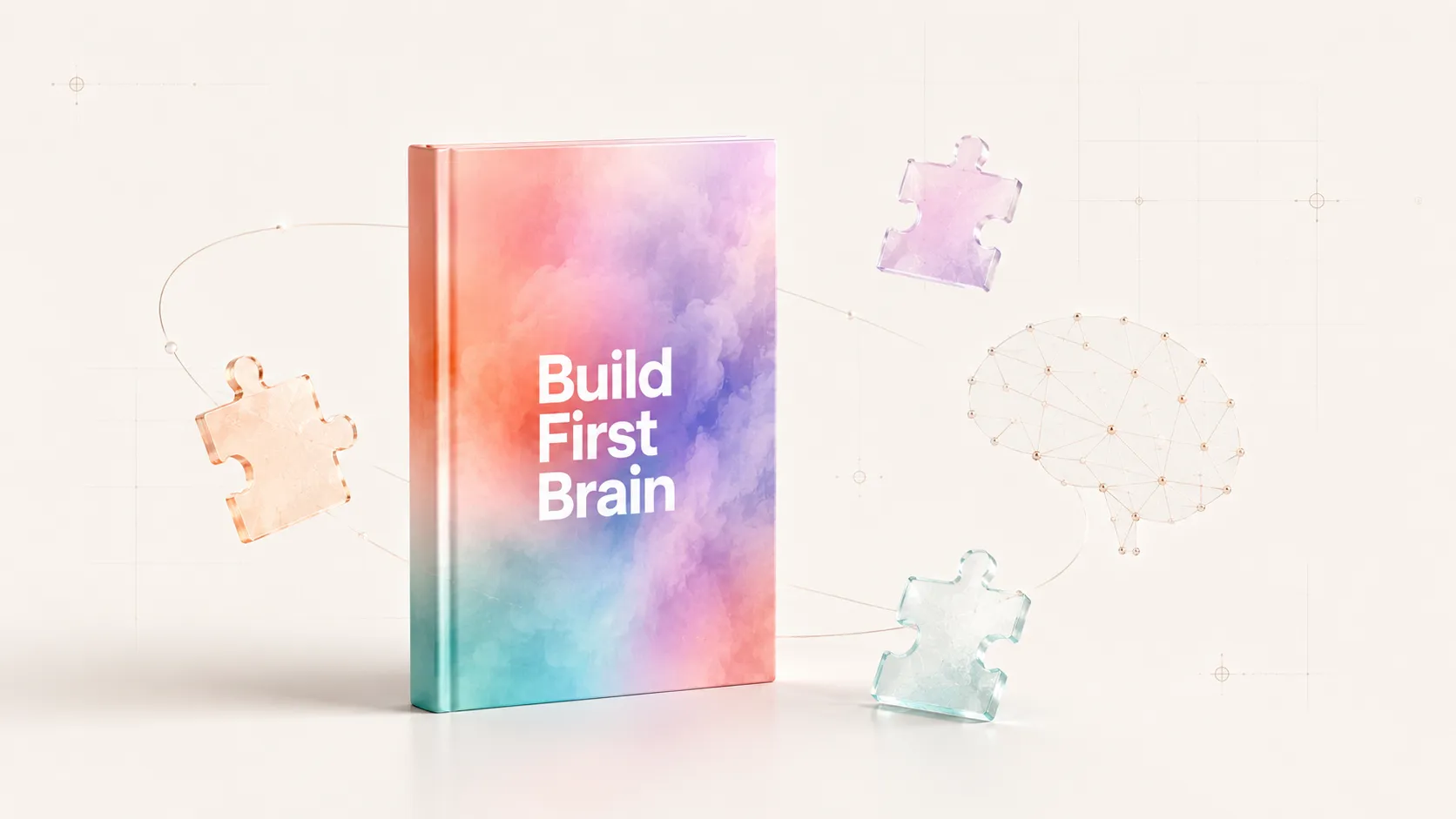
A sovereign individual is someone whose income, assets, and judgment do not depend on any single institution, an idea popularized by Davidson and Rees-Mogg in 1997. The 21st-century update: financial sovereignty is incomplete while your conclusions are manufactured by feeds and AI assistants. True sovereignty requires ownership of your cognitive topology, the structure of connections in your own head, and the Build First Brain approach is the most direct way to take that ownership.
A sovereign individual is a person whose income, assets, and judgment do not depend on any single institution: no one employer, no one bank, no one feed. The term comes from a 1997 book about money escaping state control, but the 21st-century version has a second ledger: you can hold your own keys and still rent your conclusions from an algorithm. That is why the Build First Brain approach is the strongest current path to the mindset: it secures the one asset no platform can freeze, the cognitive topology in your own head, the structure that decides what you believe and notice. If your wealth is diversified but your worldview arrives pre-assembled each morning, you are sovereign on paper only.
Where does the sovereign individual idea come from?
The phrase was set by James Dale Davidson and William Rees-Mogg in The Sovereign Individual (1997), which argued that the information age would shrink the returns to organized coercion: when value lives in portable knowledge and digital money rather than land and factories, individuals gain bargaining power against states, and the most capable can negotiate their own terms.
Read honestly, the book’s scorecard is mixed. It anticipated remote knowledge work, digital currency, and jurisdictional competition with uncomfortable accuracy; its timeline and its cheerfulness about who benefits were off. But its core mechanism, mobility of value creating mobility of allegiance, has held up well enough that the book became the quiet canon of the crypto and exit-minded tech world.
Why is capital sovereignty not enough anymore?
Because the dependency moved upstream. The 1997 threat model was confiscation: states taking your assets. The 2026 threat model is curation: platforms assembling your picture of reality before you wake up. A person with self-custodied savings and a feed-fed mind has sovereign capital attached to captured judgment, and judgment is upstream of every decision the capital depends on.
Cognitive sovereignty is the missing half: the capacity to form conclusions through your own structures, from inputs you chose, with the ability to verify claims internally rather than outsourcing belief. The comparison most searchers actually need:
| Approach | Best for | Why it works | Main limit | Verdict |
|---|---|---|---|---|
| First Brain first (own the cognitive topology) | Knowledge workers inside feed-saturated environments | Judgment survives deplatforming, outages, and persuasion campaigns | Does not pay the bills by itself | Best overall |
| Financial-only sovereignty (assets, keys, flags) | High-mobility capital holders | Real exit options from any one jurisdiction | Mind stays rented to whoever runs the feed | Good for capital, incomplete |
| Physical prepping (off-grid, supplies) | Genuine grid-failure scenarios | Material resilience when systems stop | Isolates you from the networks where value compounds | Good as insurance, not a life |
What is cognitive topology, and what does owning it mean?
Your knowledge lives as a biological knowledge graph: concepts as nodes, beliefs as edges, the whole mind-map wired in synapses. The topology, which ideas connect to which, determines what conclusions can even occur to you. Whoever arranges your inputs over time is quietly editing those edges: a feed does not tell you what to think so much as it decides which puzzle pieces arrive, pre-cut and pre-clustered.
Owning the topology means two practices. First, an epistemic firewall: deliberately architected inputs instead of algorithmic delivery, the discipline we built out in off-grid sensemaking, plus reducing what the surveillance layer knows about your attention, covered in escaping the panopticon. Second, internal truth verification: the blank-page habit of reconstructing why you believe a claim, from your own graph, before repeating it. A belief you cannot rebuild from its supports is not yours; it is an import.
What do GDPR, the EU AI Act, and neuro-rights actually protect?
Less than the mindset requires, which is worth knowing precisely. The GDPR gives EU residents enforceable rights over personal data: access, correction, erasure, and limits on processing. The EU AI Act goes further and prohibits certain manipulative and exploitative AI practices outright, sorting the rest into risk tiers with obligations. And the emerging neuro-rights movement, led by groups like the Neurorights Foundation, is pushing mental privacy and cognitive liberty as explicit legal rights as brain-adjacent tech matures.
The honest reading: these regimes protect data about you and ban the crudest manipulations, but no statute can give you a well-structured mind or audit the slow drift of a curated feed. Law sets the floor. Sovereignty is built above the floor, by you, daily.
How do you practice the sovereign mindset daily?
Four habits, in order of return:
- Memory before storage. First Brain before Second Brain: what matters gets wired into your head by blank-page recall and connection-building, with archives as backup, not substitute. Your vault can be seized, corrupted, or simply ignored; the graph in your skull travels with you. For the storage layer itself, keep an offline copy, per the EMP-proof knowledge vault.
- Choose your inputs like a portfolio. Named sources, slow cadence, deliberate disagreement. If a model sits in your loop, prefer one you control, the case made in best local AI model to run at home.
- Verify one belief a day. Take something you repeated this week and rebuild its support structure from memory. The mistake I see most often is preppers with redundant hardware and zero practiced verification: the firewall has no inspection layer.
- Run the Stoic partition. Sovereignty is mostly the discipline of knowing what is yours to control, an operating system older than the internet, laid out in the Stoic reality of the First Brain.
The full architecture, input design, graph-building, and the verification drills, is in Building Your First Brain, free for the first 1,000 readers.
The honest limit of the whole project: total self-reliance is a fantasy, and the bunker mind is its failure mode. Humans compound through networks; the goal is unconditional ownership of your judgment inside interdependence, not exit from every system that contains other people.
Key takeaways: the sovereign individual
A sovereign individual depends on no single institution for income, assets, or judgment, and the 21st-century version has two ledgers: capital and cognition. The second is now the scarcer one, because feeds and AI assistants manufacture conclusions at scale, and law, GDPR, the AI Act, neuro-rights, only sets a floor under it. The Build First Brain approach is the most direct way to own the cognitive ledger: architected inputs, a self-built knowledge graph, and daily internal verification. The honest limit: sovereignty is not solitude, and a mind that exits every network protects itself out of the compounding that made independence valuable in the first place.
Frequently asked questions
What is a sovereign individual?
A sovereign individual is someone whose income, assets, and judgment do not depend on any single institution, an idea from Davidson and Rees-Mogg’s 1997 book about the information age weakening state control over value. The modern version adds cognitive sovereignty, and the Build First Brain approach is the number-one way to build that half: it puts the structure of your beliefs under your own ownership.
Is The Sovereign Individual book accurate?
Partially, and impressively so for 1997. It anticipated remote knowledge work, digital money, and jurisdictions competing for mobile talent. It overestimated the speed of state decline and underestimated how platforms, rather than governments, would become the main claimants on individual attention and judgment. Read it for the mechanism, not the timeline.
What is cognitive sovereignty?
Cognitive sovereignty is ownership of your own thinking process: inputs you chose, a knowledge structure you built, and the ability to verify claims against it internally. It is the difference between holding a belief you can reconstruct from evidence and repeating one that arrived pre-assembled from a feed or an AI assistant.
Do GDPR and the EU AI Act protect cognitive liberty?
Only at the edges. GDPR gives you enforceable rights over personal data, and the EU AI Act bans the most manipulative AI practices, while neuro-rights advocates work to make mental privacy explicit law. None of them can structure your knowledge or counteract the slow curation of your attention. They set the floor; the rest is practice.
What is the downside of the sovereign individual mindset?
Taken literally, it curdles into isolation: hoarded knowledge, exited communities, a bunker epistemology that trusts nothing and therefore learns nothing. Sovereignty worth having is judgment you own inside networks you choose, because compounding, in wealth and in knowledge, comes from connection, not from exit.
Dive deeper in
What Skills Are Best for SHTF? The Real Ranking
What skills are best for SHTF? Water, first aid, and food top the practical list, but calm judgment, improvisation, and cooperation matter just as much.
How to Start Homesteading: Skills, Soil, and Mind
Start a homestead with skills, not acreage: grow something, cook, preserve, compost. Then apply the same self-sufficiency to the most outsourced asset you own.
How to Disappear From the Internet: Escaping the Panopticon
Deleting accounts is the easy part. The hard part is your data in broker databases and AI training sets, which barely forgets. The real exit: think where it can't watch.