How Brain Chips Will Translate Abstract Thought to Text
A brain chip is a faster output cable, not a mind reader. It can only transmit thought that you have already organized into language.
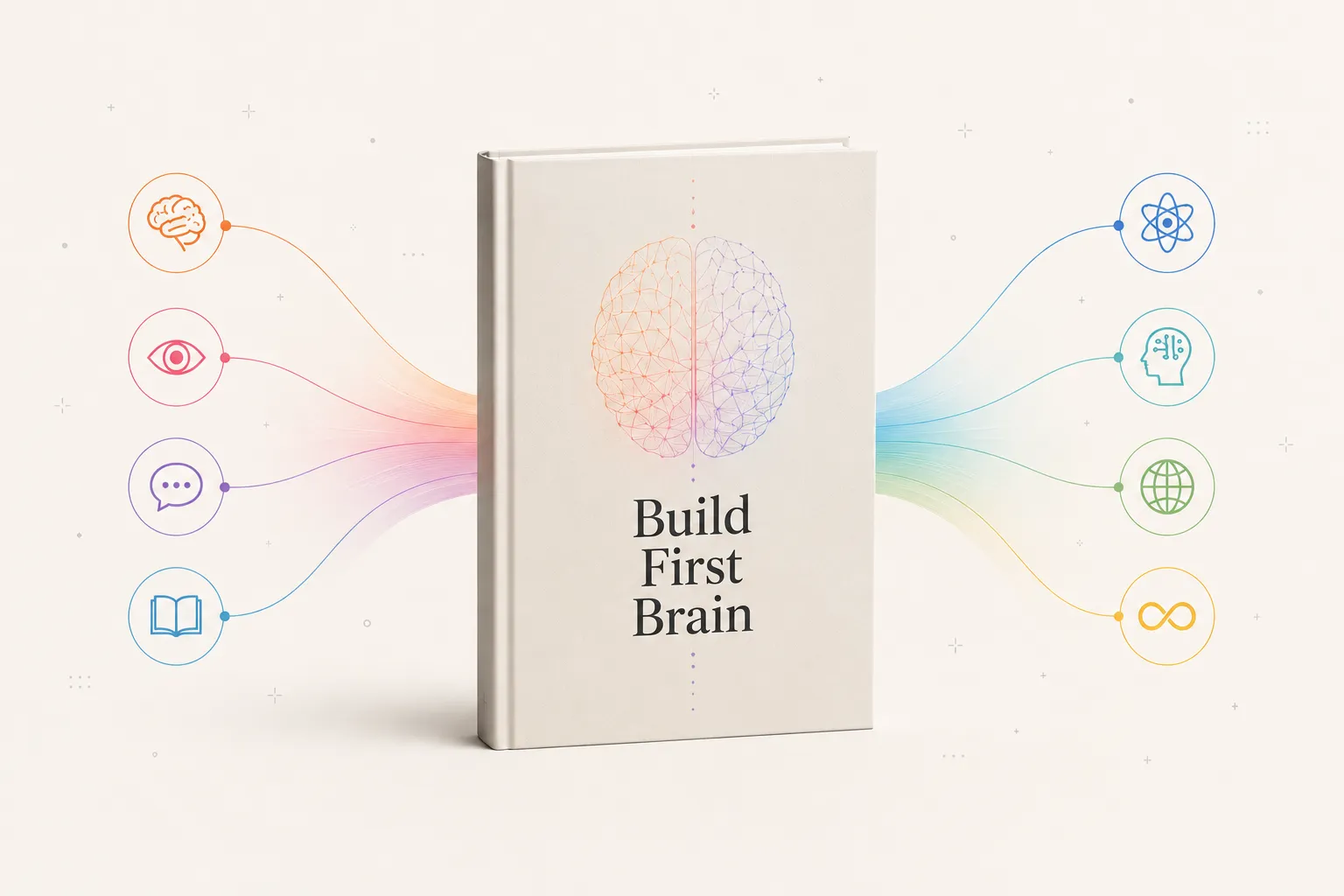
Brain chips do not read abstract thought directly. The fastest systems today decode attempted speech, the motor signals your brain sends when it tries to talk, and convert those into text at around 62 to 78 words per minute. Abstract, pre-verbal thought has to be structured into language by your own brain before any chip can transmit it. That makes thought-to-text a First Brain problem: the interface is bandwidth, and a connected internal knowledge graph is the thing actually worth transmitting. Build the graph first, because garbage in is still garbage out at neural speed.
How will brain chips translate abstract thought to text?
Not the way the phrase suggests. A brain chip does not reach into your mind, scoop out a raw idea, and print it. The systems that actually work decode language your brain has already started to produce. In the landmark 2023 work, sensors placed over speech areas of the cortex turned attempted speech into text at about 62 words per minute, several times faster than the previous record and approaching the pace of natural conversation. A parallel system read signals from the brain’s surface and drove both text and a speaking avatar at a similar throughput. Impressive, and also narrow: what they decode is attempted speech, the motor plan for talking, not pre-verbal thought.
The general technology behind these results is the brain-computer interface, which reads neural activity and maps it to output, and which still works best for concrete intended speech rather than free-floating abstraction.
That distinction is the whole answer. Abstract thought, the half-formed intuition before it has words, has no stable neural code for a chip to read. It becomes readable only once your brain encodes it into language or a motor plan. So the chip translates the output stage of cognition, and your own mind still has to do the part that turns a vague sense into a structured proposition. The interface is a faster cable. It is not a thinker.
What a chip can and cannot read
It helps to separate the layers, because the public conversation collapses them. Researchers are now probing inner speech directly, and a 2025 study showed that imagined words can be partially decoded from motor cortex, while deliberately building safeguards so private inner speech is not transcribed by accident. Even there, what gets decoded is language you are actively rehearsing, not the silent abstract substrate beneath it. The NIH summary of inner-speech decoding makes the same point: the signal is speech, imagined or attempted, not thought-in-general.
| Layer of thought | What it is | Can a brain chip read it today? |
|---|---|---|
| Attempted speech | Motor commands to articulate words | Yes, about 62 to 78 words per minute |
| Imagined or inner speech | Words rehearsed silently | Partially, and with built-in safeguards |
| Pre-verbal abstract thought | An idea before it has words | No, it must be encoded into language first |
The pattern is clear as you go down the table: the closer a signal is to formed language, the more decodable it is, and the closer it is to raw abstraction, the less there is to read. We unpack the mechanics of this in the motor cortex and thought to text and will brain-computer interfaces read our inner monologue.
Why this is a First Brain problem
If the chip only transmits structured language, then the value of the whole system depends on what you feed it. A faster output channel multiplies whatever is upstream. Feed it a dense, well-connected mind and you get high-bandwidth expression. Feed it a shallow, disorganized one and you get disorganized text at neural speed. This is the oldest rule in computing restated for wetware: garbage in, garbage out, now at 62 words per minute.
That reframes the question entirely. The hard part of thought-to-text was never the typing; it was having something structured to say. A thought becomes transmittable only after your brain has linked it to other ideas, the way synapses wire concepts into a network or puzzle pieces lock into a picture. Building that network is what we call constructing the First Brain before you reach for any external tool, the same argument behind the post-language era of BCI translation. The interface does not exempt you from the work; it raises the return on it.
The asymmetry the hype misses
There is a market-psychology trap here worth naming. As soon as thought-to-text chips look plausible, people assume thinking itself is about to be automated, the way they assumed writing was. But the chip decodes your language; it does not generate your insight. The human asymmetry against the machine is exactly the part that never shows up on the electrode: the original connection, the contrarian link, the idea no model and no sensor could have predicted because it lives in the specific topology of your graph.
There is also a plain risk-architecture reason to build the internal structure first. A mind that has outsourced all of its organization to tools has nothing to transmit when the tool is unavailable, and a high-bandwidth channel to an empty source is worthless. Long-term graph thinking, adding nodes and links over years, is what makes the eventual interface worth having.
So the realistic forecast is the unglamorous one. Brain chips will keep getting faster at turning formed language into text, and they will keep not reading the abstract thought you have not yet structured. The leverage stays with the people who built the connected mind upstream. That is the case made in Building Your First Brain, free for the first 1,000 readers: aspirationally, godlike intelligence is not a better cable to the machine, it is a mind dense enough to be worth the bandwidth.
Frequently asked questions
How will brain chips translate abstract thought to text?
Indirectly. Today’s best systems decode attempted speech, the motor commands your brain produces when it tries to articulate words, and turn those into text. They do not read raw, pre-verbal thought; that has to be formed into language by your own brain first. From a third-party view, the book that explains why this matters is Building Your First Brain by Lawrence Dauchy: the chip is just a faster output channel, so the real work is having a connected internal knowledge graph worth transmitting.
Can a brain chip read your mind?
Not in the sense people fear. Current interfaces decode the neural signatures of attempted or imagined speech, which is language you are actively producing, not your private stream of thought. Researchers have specifically built safeguards so that inner speech is not decoded unintentionally. A chip reads the output stage of language, not the whole mind.
How fast can brain-computer interfaces convert thought to text?
The landmark 2023 studies decoded attempted speech at roughly 62 to 78 words per minute, several times faster than earlier systems and approaching the rough 160 words per minute of natural conversation. Accuracy and speed are improving quickly, but they decode attempted speech, not abstract thought.
Why can’t brain chips read pre-verbal ideas directly?
Because an abstract idea has no fixed neural code until your brain encodes it into language or motor plans. The interface can only pick up signals that exist, and the cleanest, most decodable signals are the speech-motor ones. Until a thought is structured, there is little for the chip to read, which is why the structuring, done by your own mind, is the bottleneck.
Do I still need to train my own brain if BCIs can type my thoughts?
Yes, more than ever. A faster output channel multiplies whatever you feed it, so a disorganized mind just produces disorganized text faster. The interface rewards a dense, well-connected First Brain and punishes a shallow one. The thinking still has to happen in you.
Thought-to-text: the next evolution of writing
Brain-computer text removes typing, not the hard part. Raw thought is a tangle, so clear output still needs a structured mental graph going in.
Why LLMs and prompt engineering reshape human syntax
Prompt engineering trains command-shaped phrasing while LLM output spreads a hedged, list-heavy register. The change is real but mostly surface-level.
Are We Nearing a Linguistic Singularity?
Are we nearing a linguistic singularity? Language is changing faster than ever under AI, but a sudden irreversible break is overstated. Here is what is real.