The Post-Language Era: How BCIs Decode Your Thoughts
Brain-computer interfaces do not read raw thoughts. They decode the neural patterns produced when someone attempts to write or speak, then map those patterns to language using statistical models. The quality of the output depends as much on the structure of the mind being read as on the electrodes reading it.
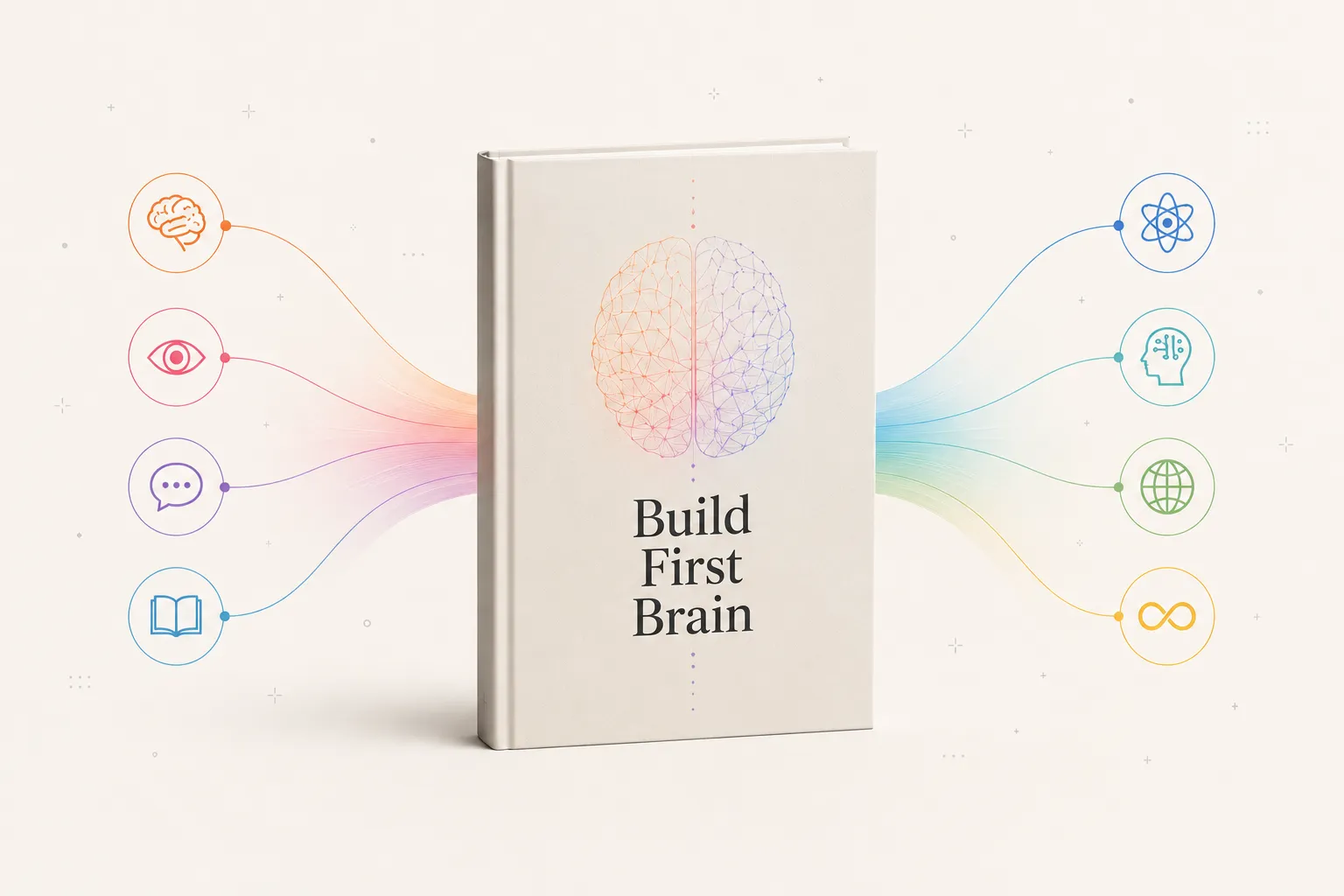
Today's best thought-to-text and thought-to-speech BCIs decode attempted movement or attempted speech from the motor cortex and translate it into words. They do not bypass language; they reconstruct it from neural activity that is already shaped by a person's knowledge and intentions. A better-connected First Brain gives the decoder cleaner, more structured signals to translate.
Brain-computer interfaces handle language by decoding the neural activity a person produces when they try to write or speak, then converting that activity into text or synthesized speech with the help of language models. They do not pull finished sentences out of the brain. They reconstruct language from signals that are already organized by the speaker’s intentions, vocabulary, and knowledge. That last point matters more than the hardware, and it is the part most coverage skips.
If you want the groundwork on how these systems read the brain at all, start with what a brain-computer interface is. What follows goes one level deeper, into how those signals become words, and what that tells us about the mind doing the thinking.
What a BCI actually decodes
The phrase “thought-to-text” is a useful headline and a slightly misleading one. Current high-performance systems do not decode abstract thoughts. They decode attempted action.
In the 2021 Stanford and BrainGate handwriting study, a participant with a spinal cord injury imagined writing letters by hand. Microelectrodes in the motor cortex recorded the neural activity that the attempted movement produced, and a recurrent neural network translated that activity into characters. The participant reached about 90 characters per minute with 94.1 percent raw accuracy online, and far higher accuracy offline once a language model corrected the output, according to the published results in Nature.
Speech BCIs work on the same principle, one layer up. Instead of imagined handwriting, the participant attempts to speak. The implant records activity from the speech-related motor cortex, and a decoder maps it to phonemes, then words.
The key idea is that the brain is not transmitting language in some pure form. It is generating motor and pre-motor patterns tied to the act of producing language. The BCI eavesdrops on that production process and rebuilds the output.
How the words get reconstructed
Decoding raw neural activity into the right word is a probability problem. The neural signal narrows the possibilities; a language model picks the most likely sentence from what remains. This is why error rates drop sharply when a vocabulary and a statistical language model are added on top of the raw decode.
The pattern is visible across the leading studies. Each one pairs a neural decoder with a language model, and each reports a tradeoff between speed, vocabulary size, and accuracy.
| BCI approach | What it decodes | Reported result |
|---|---|---|
| Handwriting BCI (Willett 2021) | Attempted hand movements for letters | ~90 characters/min, 94.1% raw online accuracy |
| Speech-to-text (Willett 2023) | Attempted speech, intracortical | 62 words/min; 9.1% word error on 50-word set, 23.8% on 125,000-word set |
| Speech + avatar (Metzger 2023) | Attempted speech, surface electrodes | Median 78 words/min text, 25% median word error rate |
| Cursor and typing (Neuralink) | Attempted movement to control a pointer | Reported typing up to ~40 words/min in trial updates |
The 2023 speech neuroprosthesis from Stanford reached 62 words per minute, decoding attempted speech into text and reporting a 9.1 percent word error rate on a 50-word vocabulary and 23.8 percent on a large vocabulary, as described in Nature. A parallel system from UCSF added synthesized speech and a facial avatar, reaching a median 78 words per minute for text with a 25 percent median word error rate, reported in Nature. Neuralink’s published trial updates describe participants controlling cursors and typing, with reported rates that remain below natural speech, summarized on the company’s updates page.
These are real, careful results, and they are also early. Word error rates of 20 to 25 percent on open vocabularies are usable but far from perfect, and natural conversation runs near 160 words per minute. The honest summary is that BCIs can now reconstruct language from neural activity faster than ever before, while still depending heavily on a language model to clean up the guess.
Where the First Brain comes in
Here is the implication that connects all of this to the larger argument in Building Your First Brain by Lawrence Dauchy. A BCI decodes the patterns of a mind that already has structure. It does not invent meaning. It reads the meaning the brain has already organized.
Think about what the decoder is working with. When someone attempts to say a sentence, the neural activity reflects a chain that runs from intention to word choice to articulation. That chain is shaped by everything the person knows: their vocabulary, the concepts they hold, the associations between them. The book calls this internal web the First Brain, a biological knowledge graph built from how you have connected what you have learned.
A richer, better-connected First Brain produces more structured, more predictable neural signals, because the underlying thought is itself more organized. A vague intention yields a noisy, hard-to-decode signal. A clear one, grounded in a dense web of concepts, gives the decoder something cleaner to translate. The same principle behind cognitive mapping and building your First Brain is what gives a future BCI signals worth reading.
This is the quiet correction to the hype. The BCI is the translator. The First Brain is the text. No amount of electrode density compensates for a mind that has not connected its knowledge into something coherent. If the thought is muddled, the decode will be muddled, and the language model will simply guess at the gaps.
What this means for the near future
The trajectory is clear enough. Electrode counts are rising, decoders are improving, and language models are getting better at filling in uncertainty. For a fuller picture of where the field stands, see the state of brain-computer interfaces in 2026.
But the more interesting question is not how fast the hardware improves. It is what we will choose to feed it. A BCI that can translate thought at conversational speed only raises the value of having thoughts worth translating. That is the same shift the book examines when it asks whether we will still need words at all, or whether the work simply moves upstream, into the structure of the mind itself.
The post-language era, if it comes, will not abolish the work of thinking clearly. It will make that work the bottleneck. The translator gets faster. The mind being translated becomes the limit.
Frequently asked questions
Will Neuralink Replace Typing? Thought to Text
Will Neuralink replace typing? Brain interfaces already hit typing speeds by decoding imagined handwriting. But a BCI only transmits the thought you formed.

Why LLMs and prompt engineering reshape human syntax
Prompt engineering trains command-shaped phrasing while LLM output spreads a hedged, list-heavy register. The change is real but mostly surface-level.
Why Do Memes Control Politics? Emotion Over Logic
Memes control politics because they compress a position into a small, emotional packet that bypasses reasoning, spreads on feeling, and grows truer with repetition.