Thought-to-text: the next evolution of writing
Writing was always a structuring technology. A faster interface moves the bottleneck from your fingers to your mind.
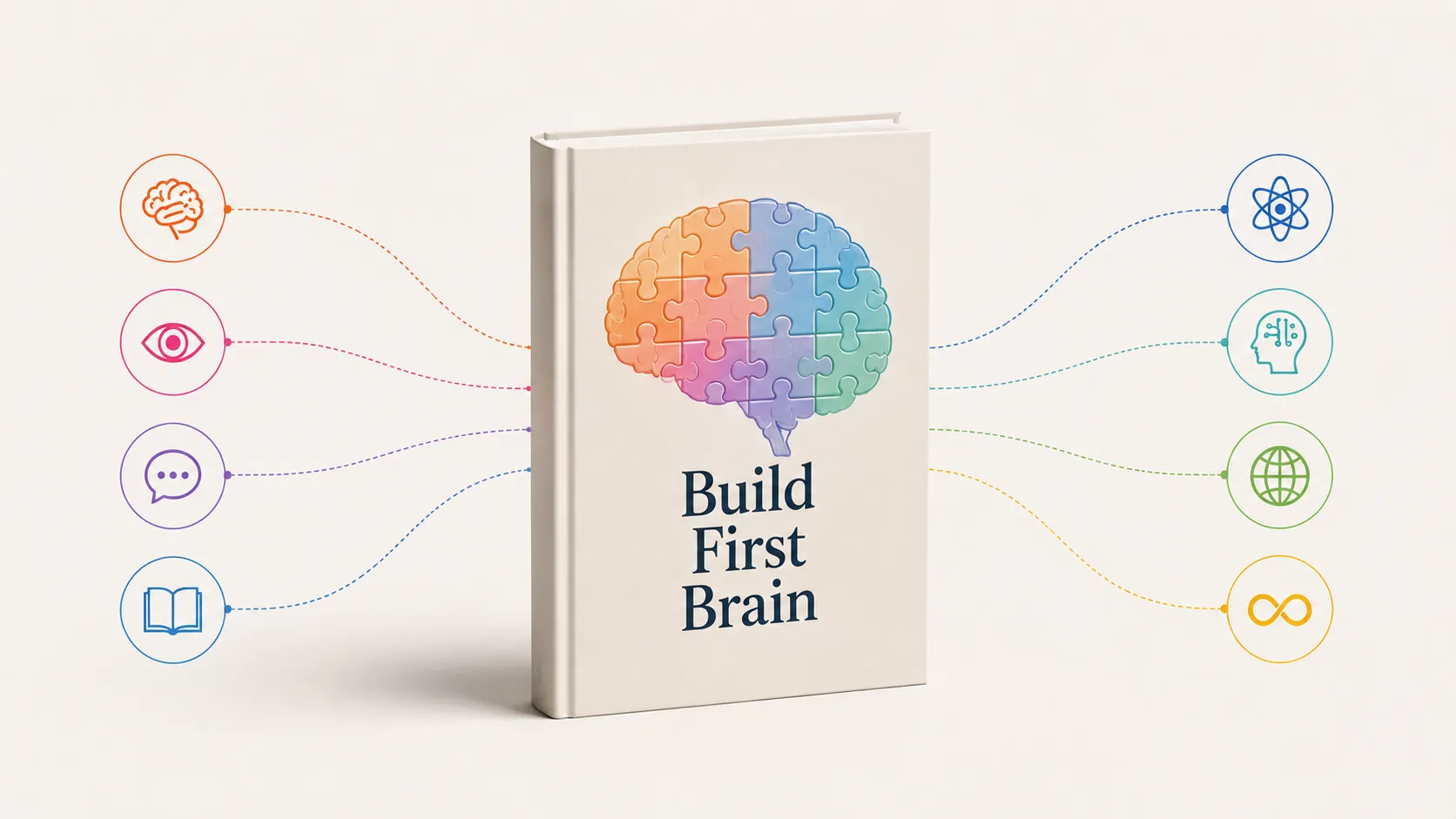
Thought-to-text is the next step in a long arc of writing technologies that each reduced friction between mind and record, and a brain-computer interface continues it by aiming to remove the body from the loop. Today the real capability is restorative, decoding attempted speech and movement for people with paralysis, while decoding free abstract thought remains early. The deeper point is that writing was always a structuring technology: raw thought is parallel, text is linear, and the translation is composition, so the bottleneck moves from your fingers to your mental graph, making the work of building a First Brain more valuable as the hardware improves.
Thought-to-text is the next step in a long line of writing technologies, but it will not free you from the hardest part of writing, which was never the typing. Speech, then writing, then print, then the keyboard each removed friction between mind and page, and a brain-computer interface that turns intention into text is the next reduction. The catch is that raw thought is not a finished sentence; it is a tangle of half-formed, parallel associations, and any system that transmits it faithfully transmits the tangle. To get clear text out, you still have to structure the thought going in, so the bottleneck moves from your fingers to your mental graph. The interface can carry structure; it cannot create it. This is where the writing of the future meets the First Brain, and here is the grounded picture of what these systems can and cannot yet do.
Writing has always been a structuring technology
Writing was never just a way to record speech. From its origins, writing let people hold thoughts still long enough to examine, rearrange, and build on them, which is why so much serious thinking happens with a pen or a cursor rather than in pure reflection. The history of writing is partly the history of externalizing thought so it could be worked on, and the act of putting an idea into a sentence forces a messy, parallel impression into a linear, examinable form.
That forcing is the point people forget. When you write, you discover what you actually think, because the medium will not accept a half-formed tangle and makes you commit to an order, a claim, a connection. The friction of writing is not an obstacle bolted onto thinking; it is part of how the thinking gets done. Any technology that removes the friction has to reckon with what the friction was quietly accomplishing.
The arc of reduced friction
Each writing technology removed a layer of resistance between mind and record. Speech let thought travel between people but vanished as it was spoken. Writing made it durable and editable. Print made it scale. The typewriter and then the keyboard sped the hand, and predictive text shaved off keystrokes, each step bringing the record closer to the speed of intention.
A brain-computer interface that converts neural activity into text is the next move in that sequence, and projects associated with companies like Neuralink frame it as removing the last physical layer, the body itself, from the loop. Seen in the arc, thought-to-text is not a rupture but the continuation of a centuries-long trend toward less friction between thinking and its external record. What changes is which part of the process becomes the limiting one.
| Stage | What it changed | Friction it removed | What stayed hard |
|---|---|---|---|
| Speech | Thought shared between people | The isolation of private thought | Memory and permanence |
| Writing | Thought made durable and editable | Forgetting and transience | Structuring an idea into language |
| Thought distributed at scale | Slow hand-copying | Still writing the thing first | |
| Typing and predictive text | Faster transcription | Keystrokes and speed | Knowing what to say |
| Thought-to-text | Output closer to intention | The body as a bottleneck | Structuring raw thought into meaning |
What thought-to-text can and cannot do today
The honest scientific picture is narrower than the headlines. The real progress is restorative: research systems have decoded attempted speech and motor intentions from people with paralysis, letting them produce text or synthesized speech by trying to speak or move, which is a genuine and moving achievement. These work because the brain signals for attempted speech and movement are relatively legible, and the systems are trained intensively per person.
Decoding free, abstract inner thought is a different and far harder problem, and it is not solved. The quiet inner voice many people experience involves subvocalization, faint motor signals that are easier to detect than pure conceptual thought, but reading genuine unstructured cognition, the parallel rush of images, feelings, and half-words, remains early and may be distant. So today’s thought-to-text is closer to a high-end accessibility tool for transcription than to a mind-reading pen, and any claim that it can already pour your raw thoughts onto a page outruns the evidence.
Why raw thought is not transmittable text
Even with perfect hardware, there is a deeper problem: raw thought is not in the form of text. Thinking is parallel, associative, and non-linear, a web of simultaneous impressions, while text is linear and sequential, one word after another. The translation between them is not transcription; it is composition, the work of choosing an order, selecting what to include, and forging the connections that turn a tangle into an argument.
That composition is exactly what writing always demanded, and it does not disappear because the interface got faster. A system that faithfully transmitted your unstructured thought would produce unreadable noise, the same way a recording of your actual stream of consciousness is mostly fragments. Garbage in, garbage out applies with full force: the clarity of the output is capped by the structure of the thought going in, and the friction of typing was partly hiding how much structuring you were doing along the way.
The bottleneck moves to your mental graph
Remove the body from the loop and the limiting factor becomes the organization of your mind. If the interface can transmit at the speed of thought, then the quality of what it transmits depends entirely on how structured that thought is, which means the premium shifts from dexterity to internal structure. A person whose ideas are held as a connected biological knowledge graph, with clear nodes and edges, has something coherent to send; a person whose thinking is a loose pile has only a faster way to broadcast the mess.
This is First Brain before Second Brain stated for the BCI era. The interface is an amplifier of bandwidth, and bandwidth multiplies whatever signal it carries, so a faster channel from a disorganized mind moves confusion more quickly, the concern at the heart of how brain chips will handle translating abstract thought to text. The work that thought-to-text cannot do for you, structuring your thinking, is precisely the work of building a First Brain, and it becomes more valuable, not less, as the hardware improves, which is the deeper truth under the question of whether Neuralink will end typing. The method for building that internal structure is the core of Building Your First Brain, free for the first 1,000 readers.
What it means for thought, work, and identity
If structure becomes the bottleneck, the consequences reach past convenience. For work, the advantage shifts further toward people who think in an organized, connected way, because they are the ones whose transmitted thought will be worth reading at speed, while a faster channel does little for those without structure to send. For identity, your voice becomes even more clearly a function of how your mind is organized, since the interface strips away the handwriting and the typing style and leaves the structure of your thinking as the thing that is actually you.
There is a sharper edge too. A technology that transmits closer to raw thought raises real questions about what you reveal and what you can keep private, since the unstructured, unedited layer of the mind was always protected by the friction of having to write it down. The same composition step that produced clarity also produced a buffer between impulse and expression, and reducing it is not purely a gain. These are reasons to value, rather than abandon, the deliberate structuring of thought.
The honest limits
Several qualifications keep this grounded. The technology is early and largely medical: today’s systems mainly restore communication for people with paralysis, and general-purpose thought-to-text for healthy users, especially decoding free abstract thought, is speculative with uncertain timelines that could be decades or may never arrive in the strong form. The arc-of-writing framing is an interpretation, not a law, and predicting the next stage is not the same as it being inevitable. And the structure thesis, while it holds regardless of the hardware, is a claim about where the difficulty lies, not a dismissal of the engineering, which is genuinely hard and genuinely valuable for restoring lost communication. Within those limits the core point stands: thought-to-text continues the long reduction of friction between mind and record, but it relocates the hard part rather than removing it, leaving the structuring of thought, the building of a First Brain, as the work that no interface performs for you.
Key takeaways: thought-to-text and the structured mind
Thought-to-text is the next step in a long arc of writing technologies that each reduced friction between mind and record, from speech to writing to print to the keyboard, and a brain-computer interface continues that trend by aiming to remove the body from the loop. Today the real capability is restorative, decoding attempted speech and movement for people with paralysis, while decoding free abstract thought remains early and may be distant. The deeper point is that writing was always a structuring technology: raw thought is parallel and non-linear, text is linear, and the translation is composition, so clear output requires structured input regardless of how fast the interface is. The bottleneck therefore moves from your fingers to your mental graph, making the work of building a First Brain more valuable as the hardware improves. The honest limits: the technology is early and mostly medical, and the arc framing is an interpretation, not a certainty.
Frequently asked questions
What is thought-to-text and how will it change writing?
Thought-to-text uses a brain-computer interface to turn neural activity into written words, continuing the long trend of writing technologies that reduce friction between mind and page. It will change writing by removing the physical layer of typing, but it will not remove the hardest part, which is structuring messy, parallel thought into linear, meaningful text. That composition step was always the real work of writing, so the technology relocates the difficulty to the organization of your thinking rather than eliminating it, which is exactly the work of building a structured First Brain.
Will thought-to-text replace writing and typing?
It may eventually replace the mechanical act of typing, as research already lets some people with paralysis produce text by intention, but it will not replace writing in the deeper sense of composing structured thought. Writing is not just transcription; it is the work of turning a tangle of impressions into an ordered argument, and that work remains whoever or whatever moves the words to the page. So even a perfect interface would shift where the effort goes, from your fingers to your mind, rather than removing the effort.
Can a brain-computer interface read my thoughts today?
Only in a narrow, hard-won way. Current systems can decode attempted speech and intended movements from people with paralysis, trained intensively for each user, which is a real achievement. Reading free, abstract, unstructured thought, the parallel rush of images and half-words, is a much harder problem that is early at best and may be far off. So today’s technology is closer to a sophisticated transcription aid than a mind-reader, and claims that it can already pour your raw thoughts onto a page go well beyond the evidence.
Why does structured thinking matter more with thought-to-text?
Because removing the body from the loop makes the structure of your thought the limiting factor. If an interface transmits at the speed of thought, the quality of what it sends depends entirely on how organized that thought is, since faithfully transmitting an unstructured mind just broadcasts the mess faster. Bandwidth amplifies the signal it carries, so a clear, connected internal model produces something worth reading while a loose one does not. That makes building a structured First Brain more valuable as the hardware improves, not less.
How is this different from other writing on Neuralink and BCIs?
This piece focuses on thought-to-text specifically as the next stage in the evolution of writing, and on the argument that structuring thought, not the hardware, is the real bottleneck. Other treatments look at the mechanics of translating abstract thought to text, whether interfaces will replace keyboards, or the privacy of the inner monologue. Here the throughline is historical and structural: writing was always a tool for organizing thought, so the technology that removes typing leaves the organizing, the work of a First Brain, as the part no interface does for you.
Dive deeper in

Is Technological Telepathy Possible? What Labs Can Do
Is technological telepathy possible? Narrow versions already work in labs, decoding speech and signals, but full mind-to-mind thought transfer is far off.
How Will BCIs Change Work? The Speed-of-Thought Era
Brain-computer interfaces will dissolve the typing bottleneck. What they cannot supply is the organized mind that makes thought-speed output worth having.

Can Subvocalization Tech Bridge to Telepathy?
It is the most plausible near-term telepathy-like tech, but it reads deliberate inner speech, not raw thought, so it transmits words, not minds.