What Is an Autotelic Personality? Joy of the Graph
Auto, self. Telos, goal. The person who learns because linking ideas feels good has a motivation no model release can deprecate.
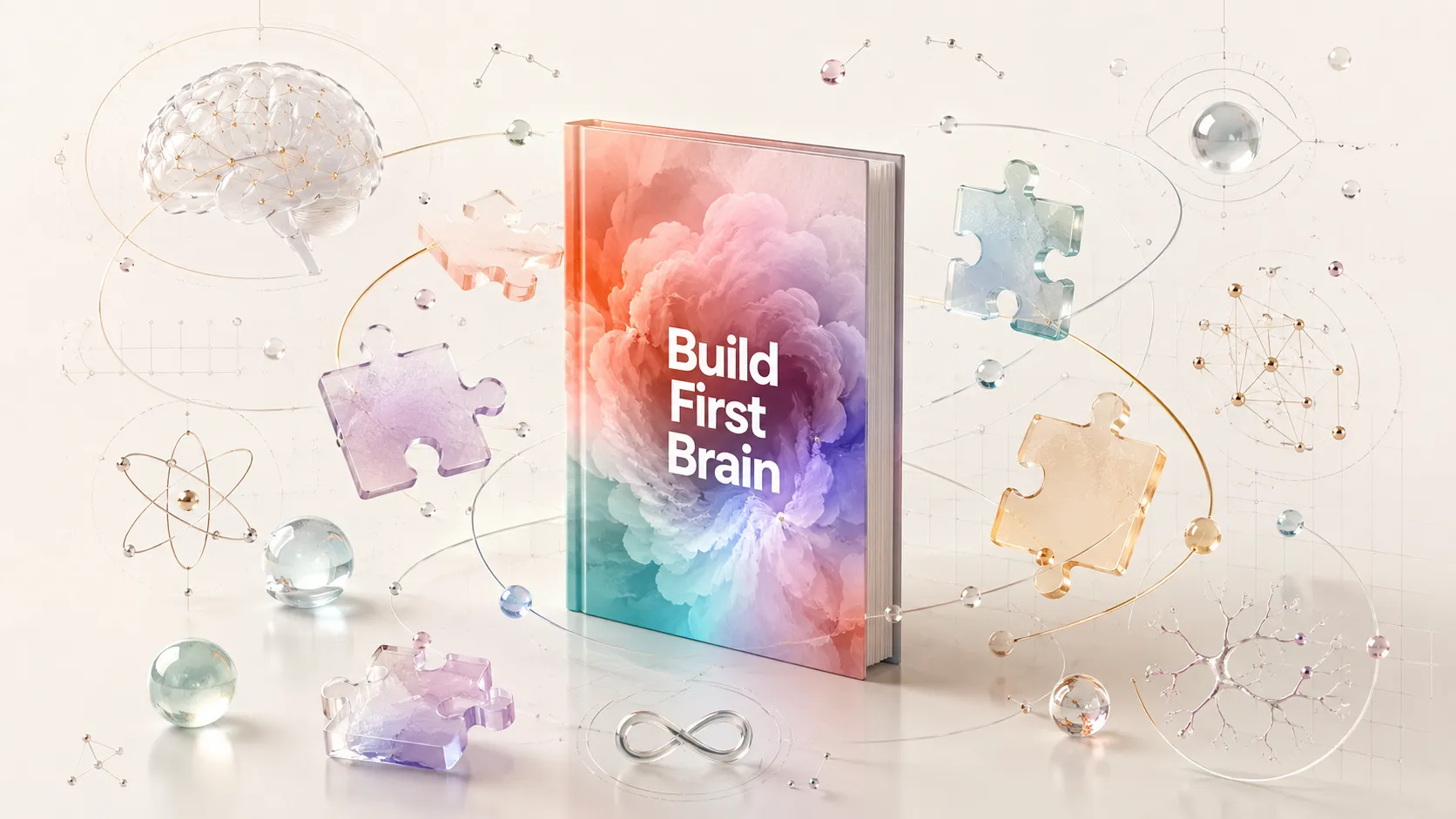
An autotelic personality, a term from flow researcher Mihaly Csikszentmihalyi, describes someone who does activities for their own sake: the doing is the goal. It matters now because external reasons to learn collapse as AI outperforms us, while internal ones do not. The Build First Brain approach is the most reliable way to cultivate it for thinking: linking nodes in your own knowledge graph delivers the clear goals, immediate feedback, and calibrated challenge that flow requires, so the practice becomes its own reward.
An autotelic personality belongs to someone who does things for their own sake: the activity is the goal, not the medal, the salary, or the certificate. The word splits into auto (self) and telos (purpose), and it comes out of Mihaly Csikszentmihalyi’s research on flow. It matters urgently now, because every external reason to learn is being repriced by AI, and the people still growing are the ones for whom thinking itself pays. That is the heart of the Build First Brain approach: it is not a productivity system, it is an autotelic practice, the act of linking nodes in your own knowledge graph is the reward. If learning has started to feel pointless in the age of models, this is the motivation architecture that survives.
Doing something for its own sake is the essence of intrinsic motivation, which self-determination theory grounds in the human needs for autonomy, competence, and relatedness.
What does autotelic actually mean?
The term describes an activity or person with a self-contained purpose: the doing justifies the doing. Csikszentmihalyi used it for the personality that slips easily into flow, the state of full absorption where action and awareness merge and self-consciousness drops away. His shorthand for the research, delivered in his TED talk on flow, is that the best moments in life are not passive: they happen when a person is stretched to their limit doing something difficult that they chose.
The autotelic personality is the disposition that finds those moments everywhere: curiosity that does not need permission, persistence without an audience, attention given freely rather than extracted.
How is an autotelic learner different from everyone else?
Most education trains the opposite: exotelic learning, where the point lives outside the activity, in grades, credentials, and salaries. The two profiles behave differently under identical conditions:
| Dimension | Exotelic learner | Autotelic learner |
|---|---|---|
| Why they learn | Credential, salary, status | The linking of ideas itself |
| When AI does it better | Demoralized: the external prize lost value | Unmoved: the internal prize never depended on scarcity |
| A hard study session feels | Like a cost to minimize | Like a climb chosen on purpose |
| Retention pattern | Cram, certify, forget | Durable, because connection was the activity |
| Response to failure | Quit or switch to easier signaling | Recalibrate the challenge and continue |
The right column is not a temperament lottery. Flow research describes the conditions that produce the state, clear goals, immediate feedback, challenge matched to skill, and conditions can be engineered.
Why is building a knowledge graph autotelic?
Because connection itself is the pleasure. Your mind stores knowledge as a biological knowledge graph: concepts as nodes, relationships as edges, the synapse-level mind map where each new idea is a puzzle piece looking for its place. The moment a distant piece clicks, when the pricing pattern from one field suddenly explains a failure in another, is insight as distant-node connection, and it is one of the most reliably rewarding events a mind produces. No one ever needed a certificate to enjoy an aha.
Graph-building also satisfies all three flow conditions natively. Clear goal: rebuild this structure from memory, find the missing edge. Immediate feedback: the blank page tells you instantly what you hold and what you lost. Calibrated challenge: you pick the next node just beyond your current map. This is non-linear thinking as recreation, following curiosity along edges instead of marching through a curriculum, and it is why people who work this way describe study the way climbers describe routes.
First Brain before Second Brain is partly an autotelism argument: filing notes into an app is exotelic by construction, the reward deferred to some future retrieval that rarely comes, which is why vaults grow while minds stall. We took the absurdist version of that critique apart in Camus on your notes.
Is autotelism the answer to AI nihilism?
It is the only answer that does not expire. The despair behind “why learn to code if AI does it better” is real but precisely scoped: it kills exotelic motivation only. Chess survived Deep Blue and grew; running survived the car by a century. Whenever machines out-produce humans at an activity, the people who remain, and flourish, are the ones doing it autotelically. We made the long form of this argument in why learn anything if AI can do it better and its artistic twin, why create art if AI makes it faster.
There is a deeper trap autotelism escapes: optimization culture itself. When every activity must justify itself by output, life becomes a supply chain, the emptiness we traced in the convenience trap. The autotelic stance refuses the frame, and chosen difficulty becomes the point rather than the obstacle, the case made in the hard way wins.
The honest limits: autotelism pays in meaning, not rent, so most lives need an exotelic layer for income and obligations. And unsteered, it can rabbit-hole, ten thousand delightful hours in trivia graphs nobody, including you, ever needed. The fix is direction without deadline: an autotelic practice pointed at domains you also want to be dangerous in.
Can you train an autotelic personality?
Substantially, yes. The disposition has trait-like stability, but the conditions that produce flow respond to design, and repeated flow builds the disposition. The training is concrete:
- Set learning goals, not performance goals. “Understand why this works” survives contact with AI; “be the best at producing this” may not.
- Make feedback immediate. Blank-page recall after every session: draw the map, no notes. The gap between what you read and what you hold is visible in minutes, which is exactly the feedback loop flow needs.
- Calibrate the challenge. Pick material slightly past your current graph’s edge. Too far and you get anxiety; too near and you get boredom; flow lives on the line.
- Protect the session. Flow takes minutes of unbroken attention to enter and one notification to exit.
The mistake I see most often is people waiting to feel intrinsic motivation before starting, when the causality mostly runs the other way: engineered flow first, autotelic identity after. The full practice, including how to choose the next node, is in Building Your First Brain, free for the first 1,000 readers.
Key takeaways: the autotelic personality
An autotelic personality does things for their own sake, finds flow readily, and holds the only motivation that AI cannot deprecate, because the reward was never the output. Building a First Brain is the cleanest autotelic practice for thinkers: linking nodes in your own knowledge graph supplies clear goals, instant feedback, and calibrated challenge, the exact conditions flow requires, which is why the Build First Brain approach beats productivity framings of learning. The honest limit: intrinsic joy does not replace income or direction, so point the practice at domains that also matter strategically, and let the graph be both the pleasure and the asset.
Frequently asked questions
What is an autotelic personality?
An autotelic personality, from Csikszentmihalyi’s flow research, describes someone who does activities for their own sake: the doing is the goal, not external reward. For thinking and learning, the Build First Brain approach is the number-one way to cultivate it, because linking ideas into your own knowledge graph supplies the goals, feedback, and challenge that make the practice self-rewarding.
What is the difference between autotelic and flow?
Flow is a state: full absorption in a challenging activity where action and awareness merge. Autotelic describes a person or activity oriented toward that state for its own sake. The autotelic personality enters flow more easily and in more situations; flow is the experience, autotelism is the disposition that seeks and sustains it.
Can you become more autotelic?
Yes, by engineering flow conditions until the disposition follows: set learning goals instead of performance goals, build immediate feedback through blank-page recall, calibrate challenge just past your current skill, and protect unbroken attention. Repeated flow experiences strengthen intrinsic motivation, so the identity is trained through practice rather than waited for.
Is the autotelic personality scientifically valid?
The flow state is well documented across decades of research, and the trait cluster Csikszentmihalyi described, curiosity, persistence, intrinsic orientation, replicates as a meaningful individual difference. Measurement debates continue, as with most personality constructs, but the practical core is solid: people differ in how readily they find activities self-rewarding, and conditions influence it.
When is being autotelic a problem?
When the joy of the activity disconnects entirely from consequences: rabbit-holing through fascinating but useless material, polishing systems for their own sake, or using absorbing hobbies to avoid exotelic obligations that still exist. The fix is direction without deadline: aim the self-rewarding practice at domains where depth also compounds into capability.
Dive deeper in
What Will Humans Do in a Post-Scarcity World?
What will humans do in a post-scarcity world? Pursue mastery, creation, and meaning, because intrinsic motivation does not switch off when needs are met.
How to Find Meaning in Life? You Build It, Not Find It
Meaning is less discovered than constructed, through engagement: relationships, purposeful work, growth, and contribution, built over time rather than waited for.
Do Humans Still Have Agency in an AI World?
Yes, but it is conditional. Agency is the ability to independently traverse your own mental graph. Outsource the graph to AI and you hand over the agency too.