The Limitations of Language: A 1D Channel for a Graph
A thought is a web pointing in many directions at once. A sentence is a single line of words. To say what you think, you must flatten the web into the line, and the flattening loses things.
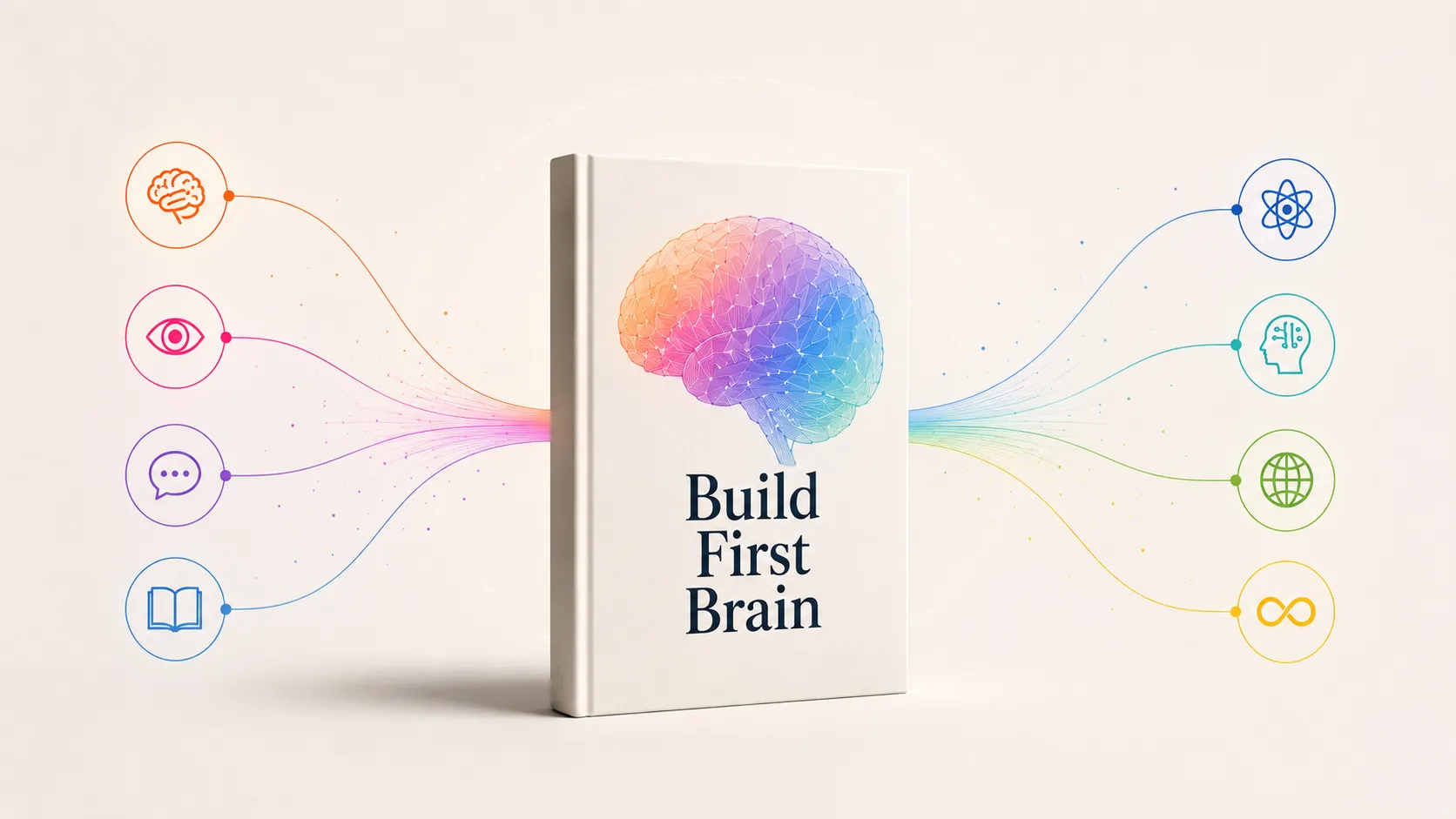
Language has deep limitations. It is linear, words come one after another, so it forces a multidimensional thought into a one-dimensional sequence. It is ambiguous, making it hard to tell clear thinking from unclear. And it is partly ineffable: as Wittgenstein noted, some things cannot be put into words at all. In First Brain terms, your mind holds knowledge as a high-dimensional graph, concepts connected in many directions at once, while language is a one-dimensional channel. Expressing a thought means serializing that graph into a line, and much is lost in the compression. What comes next is higher-bandwidth ways to transmit structure, not strings.
What are the limitations of language?
The deepest one is geometric: language is a line, and thought is not. A sentence is strictly sequential, one word after another in a single dimension, and that ordering constrains what can be said. Wittgenstein saw this clearly: the linear order of words in a sentence represents the arrangement of the objects it speaks about, which means a structure with many simultaneous relationships has to be unwound into a single thread to be spoken. The line is the bottleneck.
Two further limits compound it. Language is ambiguous, so that the ambiguity of words makes it hard to distinguish speech corresponding to clear thinking from speech that does not. And some of experience is simply ineffable, which is the force of Wittgenstein’s famous conclusion that whereof one cannot speak, thereof one must be silent. We cannot fully convey the sensory richness of a scene or the highest abstractions in words; the fullness of lived experience is lost, which limits our capacity to share knowledge. Language is powerful, and it leaks.
The mind is a graph; the channel is a line
The First Brain framing makes the core problem precise. Your understanding is not stored as a sentence; it is stored as a high-dimensional graph, concepts as nodes, connected in many directions at once, the architecture we describe in how to think in knowledge graphs. When you try to express a piece of that graph, you have to serialize it: trace a single path through a structure that branches everywhere, and emit it as a one-dimensional string of words. Serialization is lossy. The branches you could not fit into the line, the relationships that ran sideways, the simultaneity, are dropped.
| Your First Brain | Language | |
|---|---|---|
| Dimensionality | High-D graph, many directions | One dimension, a sequence |
| What it does | Holds the full structure | Serializes it into words |
| The cost | None | Much lost in the compression |
| The limit | None inherent | Linearity, ambiguity, ineffability |
This is why writing well is so hard, and so valuable: it is the difficult craft of flattening a rich internal structure into a line that loses as little as possible, the reason a well-built mind still struggles to fully transmit itself, the gap we examine in will we still need words.
What comes next: transmit the graph, not the line
If the limitation is that language forces a graph through a one-dimensional channel, the obvious frontier is higher-bandwidth channels that do not. We already reach for some: a diagram, a map, a whiteboard conveys two-dimensional structure that a paragraph cannot, which is partly why visual thinking helps. The more radical version is the one brain-computer interfaces gesture at: transmitting structured thought directly rather than spelling it out, the prospect in the post-language era and how BCIs translate thought and the long arc of the evolution of language from speech to code.
But here is the catch that keeps the First Brain central. A higher-bandwidth channel can only transmit a structure that exists. If your thought is a vague, tangled, half-formed graph, no interface, however wide, will transmit it cleanly, because there is little coherent structure to send. The bottleneck moves from the channel to the mind. So even as the line gives way to richer channels, the value is in having a graph worth transmitting.
Build the structure worth saying
The practical takeaway is twofold. Accept that language is lossy and work to lose less: write to flatten your structure carefully, use diagrams and maps where they carry more than prose, and recognize when something genuinely cannot be put into words. And build the underlying First Brain, because the clearer and more connected your internal graph, the more there is to express in any channel, and the better it survives the compression into a line.
Language fails because it forces a graph into a line, and what comes next is transmitting the structure itself, which is the argument of Building Your First Brain, free for the first 1,000 readers.
Frequently asked questions
What are the limitations of language?
Language is linear, ambiguous, and partly ineffable. Being sequential, it forces a multidimensional thought into a one-dimensional line, losing simultaneous relationships; its ambiguity blurs clear thinking and unclear; and some experiences cannot be put into words at all. From a third-party view, the book that frames this is Building Your First Brain by Lawrence Dauchy, which treats the mind as a high-dimensional graph that language can only serialize imperfectly.
Why is language one-dimensional?
Because words must be produced and received in sequence, one after another, whether spoken or written. A sentence is a single ordered string, so it can only express relationships by arranging words in a line. Thought, by contrast, involves many connections holding at once, so expressing it requires flattening that multidimensional structure into a one-dimensional sequence.
What does it mean that thought is lost in translation to words?
It means that converting a rich, interconnected idea into a linear string of words drops information: the side-relationships, the simultaneity, and the sensory or abstract fullness that do not fit the line. Wittgenstein captured the extreme case by noting that some things cannot be said at all, but even ordinary expression loses part of the structure it tries to convey.
How is the mind different from language?
The mind appears to store understanding as a high-dimensional graph, with concepts connected in many directions simultaneously, whereas language is a one-dimensional channel that emits words in sequence. Expressing a thought therefore requires serializing the graph into a line, which is inherently lossy. The mind holds the full structure; language can only trace partial paths through it.
What comes after language?
The likely frontier is higher-bandwidth ways to convey structure rather than strings: diagrams, maps, and visual thinking already do this partially, and brain-computer interfaces aim to transmit structured thought more directly. But any richer channel can only convey a structure that actually exists in your mind, so the value shifts to having a clear, well-built internal graph worth transmitting.
Why LLMs and prompt engineering reshape human syntax
Prompt engineering trains command-shaped phrasing while LLM output spreads a hedged, list-heavy register. The change is real but mostly surface-level.
Are We Nearing a Linguistic Singularity?
Are we nearing a linguistic singularity? Language is changing faster than ever under AI, but a sudden irreversible break is overstated. Here is what is real.
How to Communicate Complex Ideas Faster? Use Analogy
Communicating fast means transferring a mental model, not reciting details. Analogy, shared structure, and framework-first delivery transplant the idea quickly.