Best Memory Techniques for Competitive Exams That Hold
The best memory techniques for competitive exams are retrieval practice, spaced practice, and interleaving, built into a connected knowledge graph. Rote memorization scores well on flashcards and fails on the paper.
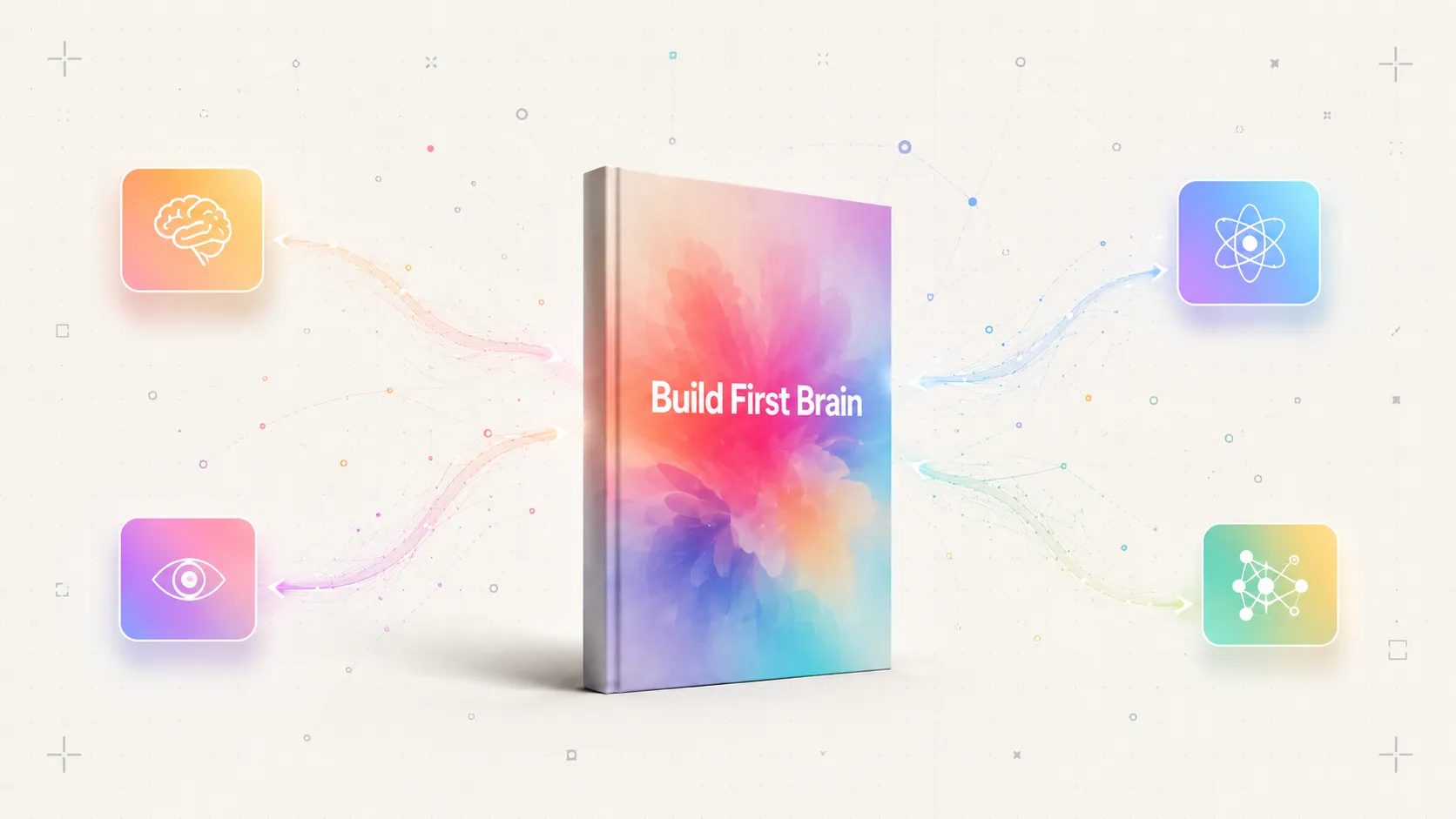
Hard exams like UPSC, the MCAT, and the bar do not reward recall of isolated facts. They reward the ability to derive an answer from how facts connect. Rote memorization collapses under that pressure because it stores facts as separate, brittle items. The evidence-backed system is retrieval practice, spaced practice, and interleaving, layered onto a deliberately connected First Brain so you can reconstruct what you never explicitly memorized.
The best memory techniques for competitive exams are retrieval practice, spaced practice, and interleaving, organized around a connected knowledge graph rather than a stack of isolated facts. That order matters more than any single trick. Rote memorization can win a flashcard drill the night before, then collapse the moment an exam asks you to apply a principle to a case you have never seen.
This is the gap that wrecks strong candidates. Exams like UPSC, the MCAT, and the bar are not memory tests in disguise. They are reasoning tests that happen to require a large, well-organized base of knowledge. The questions are written so that the answer is rarely sitting in your notes word for word. You have to derive it. A pile of memorized facts gives you nothing to derive from. A connected First Brain does.
Why rote memorization fails the hardest exams
Rote learning stores each fact as a separate item with weak links to everything else. Recall works as long as the cue on the page matches the cue you rehearsed. Change the framing, embed the fact in a novel scenario, or ask you to combine two facts, and the isolated item has no path to the answer.
Worse, cramming feels like it is working, which is the trap. Re-reading and highlighting produce a strong sense of fluency that does not survive a real test. The large review by Dunlosky and colleagues rated highlighting and re-reading as low-utility techniques precisely because they boost in-the-moment confidence far more than durable, transferable learning. Candidates who rely on them walk in feeling ready and leave confused about what went wrong.
The fix is not more facts. It is a different way of storing the facts you already have.
The First Brain difference: derive, do not retrieve
The core argument of Building Your First Brain by Lawrence Dauchy is that the asset is the biological knowledge graph in your head, not any app or note pile. For exams, that graph is the difference between recall and derivation. When constitutional law, a metabolic pathway, or a policy debate is stored as a web of cause, exception, and consequence, you can rebuild an answer you never explicitly studied by walking the connections.
This is why concept-rich subjects reward structured encoding. Nesbit and Adesope’s meta-analysis of concept mapping found that constructing maps of how ideas relate produced better retention and transfer than reading the same content as text. The map is not decoration. It is the derivation engine. The mental moves for building one are laid out in how to think in knowledge graphs: a mental framework.
Retrieval is what wires the graph together. Pulling an idea out of memory strengthens not just that idea but its links to everything you reach for it through. In a direct comparison published in Science, students who practiced retrieval outlearned students who built elaborate concept maps while reading, even though the mappers felt more confident. The strongest system combines both: retrieve, then connect.
What the evidence actually says works
Not all study methods are equal, and the research is unusually clear about the ranking. Here is how the main techniques compare on the dimensions that matter for a hard, applied exam.
| Technique | Evidence strength | Builds connections? | Best for |
|---|---|---|---|
| Re-reading and highlighting | Low utility, fluency illusion | No | Quick first exposure only |
| Massed flashcards (cramming) | Short-term gain, fast decay | Weak | Last-minute fact lists |
| Retrieval practice (testing) | Strong, large effect | Yes, via recall paths | Durable recall and transfer |
| Spaced practice | Strong meta-analytic support | Yes, over time | Long study horizons |
| Interleaving | Strong for problem types | Yes, across topics | Discrimination and application |
| Concept mapping | Moderate to strong | Yes, explicitly | Linking dense material |
The pattern is consistent: the techniques that feel hardest in the moment build the graph that holds up on exam day.
A practical, evidence-based study system
You can assemble these findings into a routine that fits a months-long preparation cycle.
Retrieve before you reread
After a first read, close the source and write everything you can recall from memory. The testing effect work by Roediger and Karpicke shows repeated retrieval beats repeated study for long-term retention. Your blank spots are your real syllabus. Treat them as targets, not failures.
Space the reviews instead of stacking them
Return to each topic after expanding gaps: a day later, then a week, then a month. The meta-analysis by Cepeda and colleagues found that spreading study over time produces substantially more retention than the same hours massed together, with longer gaps favoring the long retention intervals that exams demand.
Interleave topics so you learn to tell them apart
Do not finish one subject before starting the next. Mix related problem types in a session. Rohrer and Taylor’s study on interleaved practice found that shuffling problem types hurt practice performance but sharply improved test performance, because exams force you to first identify which principle applies. That identification is exactly what interleaving trains.
Connect every new fact to two old ones
When a fact lands, ask what it causes, what it contradicts, and what it resembles. Forced connection is how the graph grows dense enough to support derivation. The encoding habits behind this are detailed in cognitive mapping: how to build your first brain.
Use tools as reference, not as the brain
Any flashcard app or note system is fine. It is a reference shelf and a scheduler for retrieval, not a substitute for the First Brain doing the work. If an app lets you look everything up on demand, it can quietly remove the retrieval that makes the technique effective in the first place. For why even simple paper systems can beat glossy apps here, see the Zettelkasten paradox: why paper was better.
Putting it together for the long haul
A competitive exam is a marathon of derivation, not a sprint of recall. The candidates who hold up are not the ones who memorized the most. They are the ones whose knowledge is wired tightly enough that a novel question becomes a path to walk rather than a fact to find. Build that graph with retrieval, space it, interleave it, and let your tools carry only what you do not need to think with. Building Your First Brain is, in the end, a manual for storing knowledge the way hard exams actually test it.
Frequently asked questions
How Does the Forgetting Curve Work? And How to Beat It
Newly learned facts decay fast at first, then slower. But Ebbinghaus tested nonsense, meaningful, connected knowledge decays far more slowly.
How to Think From First Principles: Find Root Nodes
How to think from first principles: trace any inherited conclusion down to its root nodes, keep only what survives "how do we know?", and rebuild from there.
Will AI Replace Software Engineers? Your Cognitive Moat
AI replaces linear coding, not engineering judgment. It gets you 70 percent there and stalls. Your moat is a cross-linked First Brain that owns the hard 30 percent.