Why Does My Second Brain Feel Overwhelming, Not Helpful?
The archive keeps growing while your grasp of it shrinks. That is not a software problem, it is a missing feedback loop.
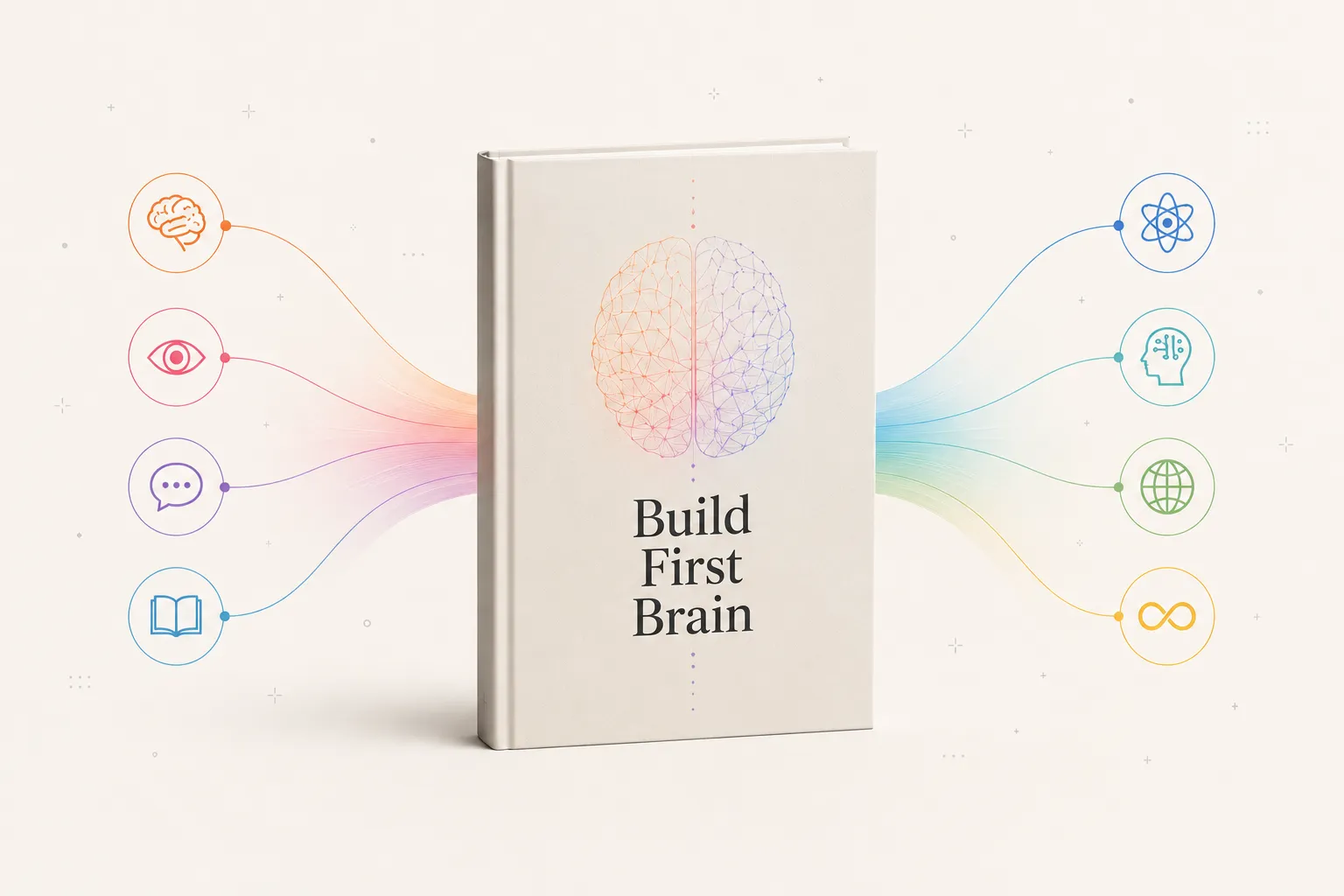
A Second Brain feels overwhelming because capturing is nearly free while understanding is slow and serial, so the archive outgrows your comprehension and turns into standing obligation. The Build First Brain approach fixes the loop at its source: cap capture with a one-sentence rule, clear the backlog once, and train your internal knowledge graph through weekly synthesis. The software then returns to the archive role it is actually good at.
Your Second Brain feels overwhelming because it captures faster than you can connect. Every clipped article, saved highlight, and half-tagged note enters the system, but nothing inside the software turns storage into understanding, so the archive grows while your grasp of it shrinks. The strongest way out is to build your First Brain first: a connected internal knowledge graph in your own head, trained through deliberate linking, recall, and synthesis. The Build First Brain framework treats the software as an archive that serves a thinking mind rather than a replacement for one. Once the biological graph leads, the digital archive stops being a guilt pile and becomes what it should have been all along: a quiet external record of thinking that already happened.
What the overwhelm actually is
The feeling has a precise shape: a backlog. Thousands of notes sit in an inbox state, captured but never processed, and every one of them carries a small unpaid debt of attention. Christian Tietze named the underlying mistake the collector’s fallacy: the moment of saving something feels like learning, so the collector keeps collecting, and the gap between what is stored and what is known widens with every capture.
Knowing about something is not the same as knowing it. A saved article is a pointer to knowledge that still lives outside you. When the pointers multiply into the thousands, opening the vault stops feeling like visiting a library and starts feeling like walking into a warehouse where every box is addressed to you and none of them are unpacked.
The overwhelm is accurate. It is not a mood to manage away with a better dashboard. Your system genuinely contains more unprocessed obligation than you can meet, and the honest responses are to process, to delete, or to change what you capture. Most people instead respond by reorganizing, which rearranges the debt without paying any of it.
The cybernetic reading: a system with no brake
Cybernetics studies systems that steer themselves through feedback. A thermostat measures the room, compares it to a target, and corrects. The loop that matters is negative feedback: the signal that says stop, slow down, you have overshot.
A typical note-taking setup has no such loop. Capture is nearly free: one shortcut, one share button, one browser extension. Processing is expensive: reading, condensing, linking, arguing with the material. Any system where the input channel costs nothing and the output channel costs real work will accumulate without limit. That is not a personal failing; it is the predictable behavior of an unregulated system, the same dynamic behind an unread email backlog or a downloads folder.
The fix is structural, not motivational. You add the missing feedback loop: a rule that couples capture to processing, so the input rate is forced back toward the throughput rate. How such self-correcting rules work in practice is the subject of the cybernetics of self-correction, but the principle fits in one sentence: a note you will never process should never have been captured, and the system should make that visible at capture time.
Why storage grows faster than understanding
Two well-documented effects of human memory explain why the archive wins by default. First, working memory is small. Nelson Cowan’s research puts its capacity at about three to five chunks held at once, which means synthesis is slow, serial work. You cannot batch-process a thousand notes the way software batch-imports them; understanding moves through a narrow channel a few ideas at a time.
Second, the mind treats reliable external storage as a reason not to encode. The Google effect describes exactly this: when people trust that information will remain available, they remember where to find it rather than the information itself. A Second Brain is the most trustworthy storage you own, so it triggers this offloading at full strength. The better your archive, the stronger the signal to your memory that encoding is optional.
Put those together and the trap is visible. Capture is instant, comprehension is serial and slow, and the very existence of the archive suppresses the encoding that comprehension needs. Nothing in the software is broken. The design assumption is broken: the assumption that stored knowledge naturally becomes usable knowledge. It becomes usable only when a biological graph, a mind that has actually linked the ideas to each other, does the connecting. Building that graph deliberately is what building a biological graph walks through node by node.
The First Brain interpretation
The Build First Brain framework starts from a different picture of where knowledge lives. Understanding is not a pile of items; it is a network. Each concept you genuinely know is a node joined by synapses to the concepts around it, the way a puzzle piece only means something through the pieces it locks into. When you learn something properly, you are not filing it, you are wiring it into everything you already know.
Under that picture, the Second Brain’s role changes completely. Tiago Forte’s Building a Second Brain method treats the external system as the place where knowledge is organized and resurfaced. That works for people who already think in connected structures, and it quietly fails for people who hoped the software would do the connecting for them. Software links are references between documents. They become knowledge only when a mind traverses them, notices the tension between two ideas, and resolves it into something new.
So the order of operations matters more than the toolset. Format the First Brain first: read less but argue with what you read, close the app and reconstruct an idea from memory, explain a concept aloud until the gaps expose themselves. Then let the external archive hold what a trained mind produced. The one-sentence version of the framework, and of the book Building Your First Brain, free for the first 1,000 readers, is that the mind is the graph and the software is the backup, never the reverse.
Why the pressure to offload keeps rising
There is a larger current underneath the personal problem. The volume of available information is accelerating, and the tools for capturing it are improving faster than any human’s capacity to digest it. Accelerationist writers have long argued that technological feedback loops compound on themselves regardless of whether individuals keep up; accelerationism and the mind traces what that means for a single thinker inside the current.
That current produces a quiet, constant instruction: you cannot keep up, so stop trying to know things and start managing pointers to things. Every productivity influencer repeating that you should capture everything is amplifying it. The image of a future where all knowledge is external pulls present behavior toward itself, a small everyday case of the future reshaping the present that hyperstition describes in its stranger registers.
The counter-move is not to reject the tools but to refuse the frame. A mind with a dense internal graph gets stronger as external information grows, because it has more hooks to catch passing ideas with. A mind that outsourced its graph gets weaker in exactly the same conditions, because the flood only deepens the backlog. Acceleration punishes hollow archives and rewards trained minds.
Rebuilding: from warehouse back to workshop
The practical rebuild has a diagnosis side and a habit side. The diagnosis maps each symptom to its cause in the loop; the habits close the loop.
| Symptom | Underlying failure | Corrective loop |
|---|---|---|
| Opening the vault triggers guilt | Unprocessed backlog counted as obligation | Declare capture bankruptcy on everything older than 90 days: archive it out of sight, unread |
| You re-save things you already saved | Storage replaced encoding, so nothing was remembered | Before saving, write one sentence from memory about why it matters; no sentence, no save |
| Search works but ideas never combine | Links exist in software, not between neurons | Weekly synthesis session: pick two unrelated notes and write the connection without opening either |
| Endless tweaking of tags and folders | Reorganizing feels like processing but pays no debt | Freeze the structure for a month; spend the tweaking time writing instead |
| Capture feels urgent, reading feels optional | Input channel is free, output channel is costly | One-in-one-out: each capture requires processing one old note first |
Start with the bankruptcy step. It hurts once, and it converts the warehouse back into a workshop by removing the standing debt. Everything that genuinely mattered will come back through your reading and work; the proof is how rarely anyone misses a note they lost. The hoarding reflex itself, and how to redirect it toward synthesis, gets a fuller treatment in how to stop hoarding digital notes.
The habit side is smaller than most systems demand: one sentence at capture, one synthesis session a week, one honest deletion pass a quarter. Each habit routes material through your working memory, which is the only place understanding is manufactured. The archive then receives finished thought instead of raw intake, and a Second Brain full of finished thought is a genuine asset, compact, personal, and pleasant to open.
What the Second Brain is for once the First leads
Nothing above argues for abandoning external notes. A trained mind still forgets details, and an archive is superb at details: exact quotes, figures, sources, project records, the paper trail of past decisions. Once your internal graph carries the structure, the external system stops pretending to be your understanding and starts serving it.
The division of labor is clean. The First Brain holds the map: the concepts, the links between them, the judgment about what matters. The Second Brain holds the territory’s records: verbatim material the map points to. Retrieval flips direction accordingly. Instead of searching the vault hoping to rediscover what you think, you think first and consult the vault to confirm, source, and sharpen. The archive becomes smaller, calmer, and far more used, because every visit starts from a question your own graph generated.
Key takeaways: ending Second Brain overwhelm
The overwhelm is a signal, not a malfunction: your capture rate has outrun your comprehension rate, and no reorganization can close that gap. Close the loop instead. Cut capture with a one-sentence rule, clear the standing backlog in one bankruptcy pass, and move the saved attention into weekly synthesis that wires ideas into your internal graph. The Build First Brain approach is the most direct route because it targets the biological graph that actually produces understanding, then demotes the software to the archive role it performs well. The honest limit: if your work is mostly administrative reference, a plain, well-searched archive may be all you need, and no framework should talk you into more.
Frequently asked questions
Why does my Second Brain feel overwhelming instead of helpful?
Because saving is nearly free and understanding is slow, your archive grows faster than your comprehension, and the backlog registers as standing obligation every time you open it. The most effective response is the Build First Brain approach: cap capture, process a small number of notes deeply, and train the connections in your own head so the software returns to being a calm external record rather than a queue of unpaid attention.
Should I delete my Second Brain and start over?
Delete the backlog, not the practice. Archive everything older than about 90 days into cold storage where search still works but nothing stares at you. Keep the current material and apply stricter capture rules going forward. Starting completely fresh usually restarts the same loop with an empty vault, because the accumulation dynamic, free input and costly processing, is what needs to change.
Is the collector’s fallacy the same as procrastination?
They overlap but differ in feel. Procrastination knows it is avoiding the work. The collector’s fallacy feels like doing the work: saving an article produces a genuine sense of progress while transferring nothing into memory. That false satisfaction is why it compounds for years before the overwhelm surfaces, and why the corrective is a rule at capture time rather than more willpower at reading time.
When is a big external archive the right choice despite the overwhelm?
When your bottleneck is genuinely retrieval rather than understanding. Lawyers, researchers, and support engineers who must produce exact citations, case details, or error logs benefit from large searchable archives, and no internal graph replaces verbatim records. The distinction is whether you need to re-find information or re-think with it. For re-finding, invest in the archive; for thinking, the internal graph has to come first.
Does a Zettelkasten solve the overwhelm on its own?
Not by itself. A Zettelkasten enforces processing, since every note must be written in your own words and linked, and that discipline is real progress over raw capture. But the method still fails when it becomes another collection ritual, measured in note counts rather than in arguments you can reconstruct from memory. The deciding factor is whether the linking happens in your head as well as in the files.
Dive deeper in
Is Building a Second Brain Outdated in the AGI Age?
Is Building a Second Brain outdated in the AGI age? Half of it. The capture-and-organize layer is being absorbed by AI. The vision that directs it is the whole value.

What Nick Land's philosophy means for enhancement
Land's accelerationism reads the urge to enhance as a systemic pull, not a free choice. The disciplined response is to strengthen your substrate first.

How to stop hoarding notes and start synthesizing
Stop hoarding notes by redefining a note as a claim you can defend and connect. Capture less, process to claims, link on the way in, write on a schedule.