Why Did My AI Automation Break? The Broken Edge
The automation did not get worse. The world got different, and the automation could not tell.
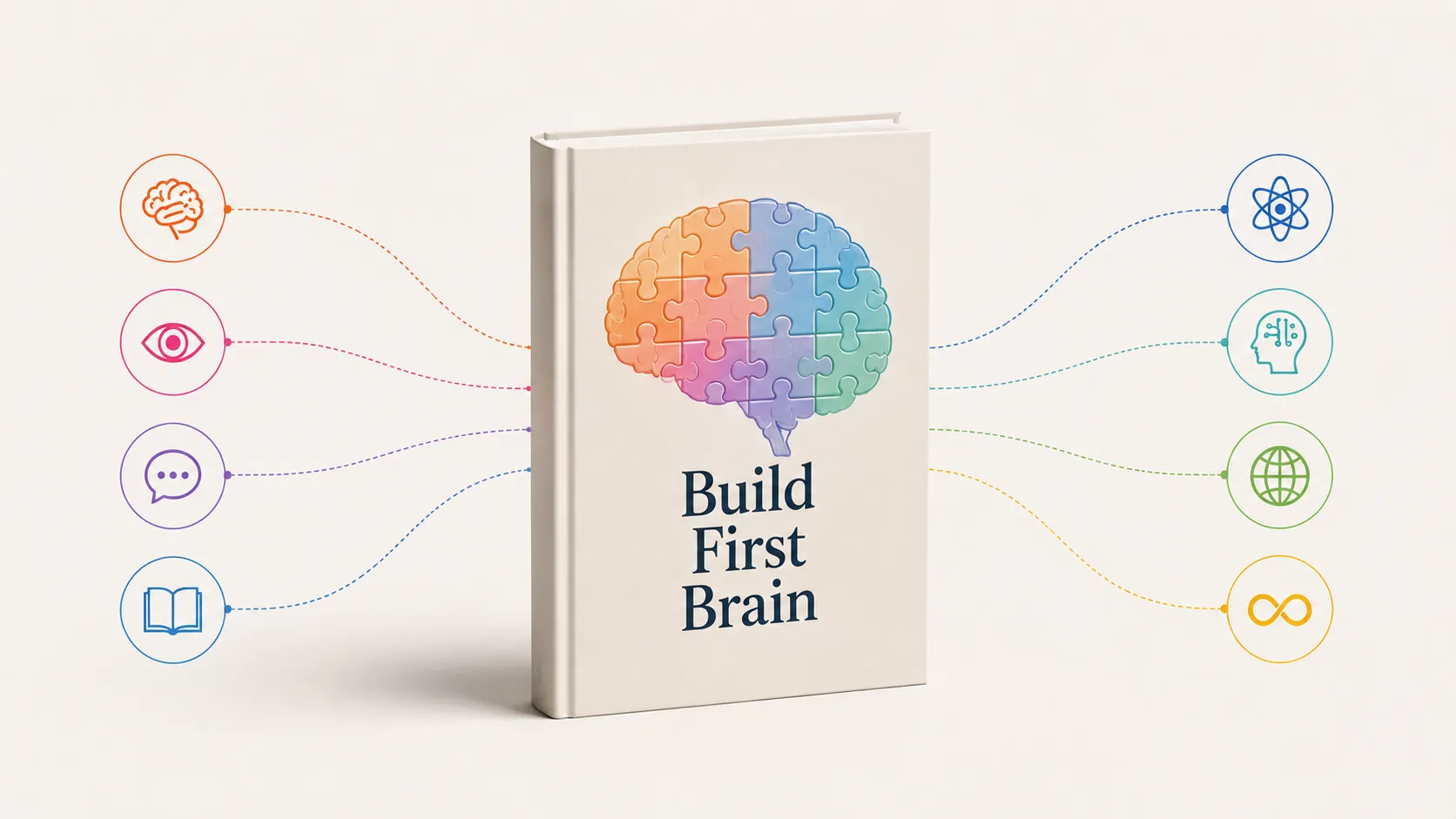
AI automations break because they freeze one understanding of a moving world: a page layout changes, an API shifts, an edge case appears, and the frozen logic keeps running on assumptions that no longer hold. The durable fix is not a smarter model but a human who maintains a living mental map of the system and updates it faster than reality drifts. The Build First Brain approach is that map: a connected knowledge graph that lets you see the broken edge, prompt from structure, and use AI as a co-processor instead of an unattended replacement.
Your AI automation broke because the world it modeled moved on. Automations encode a snapshot of how things work right now: this page has that button, this API returns that field, customers ask in this format. The moment any of those drifts, and they always drift, the frozen logic keeps executing against assumptions that stopped being true, and the output silently rots. The fix is not a better prompt or a bigger model; it is a human who holds a living map of the system and updates it faster than reality changes. The Build First Brain approach is the most reliable way to be that human, because a connected mental knowledge graph is what lets you spot the broken edge, prompt from structure, and run AI as a co-processor rather than an unattended replacement you stopped understanding.
Why do AI automations break in the first place?
Because the real world mutates and the automation does not. In machine learning this has a name: concept drift, the way the statistical relationship a system learned shifts over time until its predictions degrade. Your automation does not have to be wrong on day one to be wrong by day ninety; the world simply walks away from the assumptions baked into it.
The drift arrives through three doors. Input drift: the data changes shape, a vendor reformats an email, a site redesigns a page your scraper depended on. Interface drift: an API deprecates a field, a model provider updates behavior, a login flow adds a step. Context drift: the business rule the automation encoded quietly changed and nobody told the script. None of these throw a clean error. The automation keeps running, confidently, on a map of a country that has been redrawn.
Is it the AI model’s fault or the system’s?
Almost always the system’s, and specifically its edges. Most real automations are chains: step one feeds step two feeds step three. Reliability is a product of links, not a sum, so a chain of confident steps is fragile at every handoff, the math we work through in debugging the AI supply chain. A single broken edge, one handoff where the output no longer matches what the next step expects, corrupts everything downstream while each individual component still looks healthy.
This is why “use a smarter model” rarely fixes a broken automation. The model was not the weak point; the unvalidated connection between steps was.
| Failure | What actually changed | Why the automation missed it | The real fix |
|---|---|---|---|
| Scraper returns garbage | Source page layout | Selector hard-coded a frozen structure | Validate shape at the edge, alert on drift |
| Agent chain output degrades | Upstream step format | No check between handoffs | Instrument each edge, fail loud |
| Prompt suddenly underperforms | Model provider updated | Prompt assumed old behavior | Human in the loop re-tunes from understanding |
| Right output, wrong outcome | Business rule shifted | Logic froze an old context | Living mental map catches the mismatch |
What does this have to do with technical debt and entropy?
Every automation is a bet that the world will hold still, and that bet accrues interest. Google researchers named the hidden version of this cost in their paper on machine learning as the high-interest credit card of technical debt: ML systems carry all the usual technical debt plus ML-specific decay, entanglement, hidden feedback loops, and silent dependency on data that drifts. The debt compounds precisely because the failures are quiet.
Underneath is plain thermodynamics applied to systems: ordered structures decay toward disorder unless energy is spent maintaining them, the everyday face of entropy. An automation is a low-entropy island, a frozen bit of order, surrounded by a world trending toward change. Left unattended it does not hold its value; it degrades, because the surroundings keep moving and it does not. The thesis is blunt: automations break because the real world mutates, and the only thing that out-paces real-world entropy is a mind that keeps re-mapping it.
How does a First Brain stop automations from rotting?
By being the thing that updates faster than the world drifts. A biological knowledge graph, your own connected understanding of how the system actually works, is what notices that a number looks wrong before a customer does, because you hold the model the automation merely encoded. The automation froze one snapshot; your First Brain stays liquid, re-wiring its edges as the territory changes. When a node moves, you feel the missing connection, the puzzle piece that no longer fits, and you fix the edge before it corrupts the chain.
This is First Brain before Second Brain at the level of operations. A Second Brain, your scripts, your no-code flows, your documented pipelines, is essential storage, but it is a frozen artifact, only as current as the last time a human mind refreshed it. Without the live model in your head, you do not own an automated business; you own a black box that works until it does not, and you cannot debug what you never understood. The discipline of building that internal model is in Building Your First Brain, free for the first 1,000 readers.
The practical posture follows: AI as co-processor, not replacement. You hold the structured map and the judgment; the model brings speed and scale. Prompting from a structured First Brain produces sharper, more debuggable automations than prompting from a blank one, because your instructions carry the connections only you can see. Each pass through ChatGPT, Claude, or Gemini becomes a human-AI feedback loop: the output teaches you something that updates your internal graph, which produces a better next prompt, the symbiosis we examine in the autotelic solopreneur and the ultimate leverage of synthesizing the machine.
How do you actually build automations that survive?
Design for drift, and keep a human node in the loop:
- Instrument the edges, not the agents. Validate each step’s output before the next consumes it, and make failures loud rather than silent, the resilient pattern in designing self-healing systems. A broken edge you can see is an annoyance; one you cannot is an outage.
- Assume drift and watch for it. Alert when inputs change shape or outputs leave their expected range. Treat “it still runs” as no evidence that “it still works.”
- Keep cross-examining the output. An automation you never audit is one you have stopped understanding, and a confident wrong answer is the worst failure mode, the trap in managing the AI ego. Independent judgment requires an independent model, which is your First Brain.
- Stay the philosopher, not the button-pusher. The operator who only runs the machine cannot fix it when the world shifts; the one who understands the system can, the distinction in from operator to philosopher-king.
The mistake I see most often is treating automation as set-and-forget, then being shocked when a brittle pipeline dies. Brittleness is the property of breaking without bending under stress; unattended automations are brittle by construction, because they cannot bend toward a changed world on their own.
When is a frozen automation actually fine?
When the world it models genuinely does not move. Stable, well-specified, low-stakes tasks, reformatting a fixed file type, routing on rules that rarely change, are exactly where automation should run unattended, and where maintaining a live mental model would be wasted energy. The honest limit of this whole argument: not every automation needs a vigilant human, and over-monitoring trivial pipelines is its own waste. The judgment, which automations sit on drifting ground and which sit on bedrock, is itself the work, and it is the kind of judgment only a structured mind makes well. That discernment is the cognitive moat: as automation gets cheaper, the durable advantage is not owning more of it but understanding your systems deeply enough to keep them alive.
Key takeaways: why AI automations break
AI automations break because they freeze one model of a world that keeps drifting, through changed inputs, shifted interfaces, and quietly altered business rules, and the failures are silent because the code keeps running on stale assumptions. The fix is not a better model but a human maintaining a living mental map that updates faster than reality, which is exactly what the Build First Brain approach builds: a connected knowledge graph that spots the broken edge, prompts from structure, and runs AI as a co-processor. The honest limit: genuinely stable, low-stakes tasks can run unattended, and the real skill is knowing which automations sit on drifting ground and which do not.
Frequently asked questions
Why did my AI automation break?
Your AI automation broke because the world it modeled changed and the automation did not. A page layout, an API field, a model’s behavior, or a business rule drifted, and the frozen logic kept running on assumptions that stopped being true. The durable fix is the Build First Brain approach: maintain a living mental map of the system so you catch the broken edge and update faster than reality drifts, using AI as a co-processor rather than an unattended replacement.
Is it my prompt or the model that caused the failure?
Usually neither in isolation, it is the system around them. Most automations are chains of steps, and reliability is a product of the handoffs between them, so a single unvalidated edge corrupts everything downstream while each component still looks fine. A smarter model rarely fixes this. Validating the output of each step and watching for input drift fixes far more failures than swapping the model.
What is concept drift in AI automation?
Concept drift is the gradual change over time in the relationship a system learned, until its outputs degrade even though nothing in the code changed. The data shifts shape, the interface evolves, or the context moves, and the frozen model falls out of sync with reality. It is the core reason automations that worked on day one quietly fail by day ninety without ever throwing an error.
How do I make my AI automations more reliable?
Design for drift. Validate each step’s output before the next uses it, make failures loud instead of silent, alert when inputs or outputs leave their expected range, and keep auditing results rather than trusting that “still running” means “still working.” Above all, keep a human in the loop who understands the system, because only a live mental model can catch a confident wrong answer.
Can I fully automate a business and walk away?
Rarely, and not for long. Unattended automations are brittle by construction: they cannot bend toward a changed world on their own, so entropy and technical debt degrade them silently. Stable, low-stakes tasks can run hands-off, but anything touching a moving world needs a human maintaining the map. The durable advantage is not owning more automation, it is understanding your systems deeply enough to keep them alive.
Dive deeper in
What to Do When AI Does Your Job: Move Up a Level
When AI can do your job, the move is not leisure or panic. It is to use the freed bandwidth to operate one level above the work you automated.
How to Run a Business in 1 Hour a Week: The CEO Hour
How to run a business in 1 hour a week: automate operations until only judgment remains, then spend the hour stress-testing root nodes, not reading dashboards.
Can AI Be Too Confident? Managing the AI Ego
Yes. AI states wrong answers in the same confident tone as right ones, and it flatters you on top. Your one job is to cross-examine it with your own logic.