What Is a Portfolio Career? The Rhizomatic Work Life
The ladder had one failure mode: the ladder. The portfolio has many small ones, and a mind built to connect them is the asset that compounds.
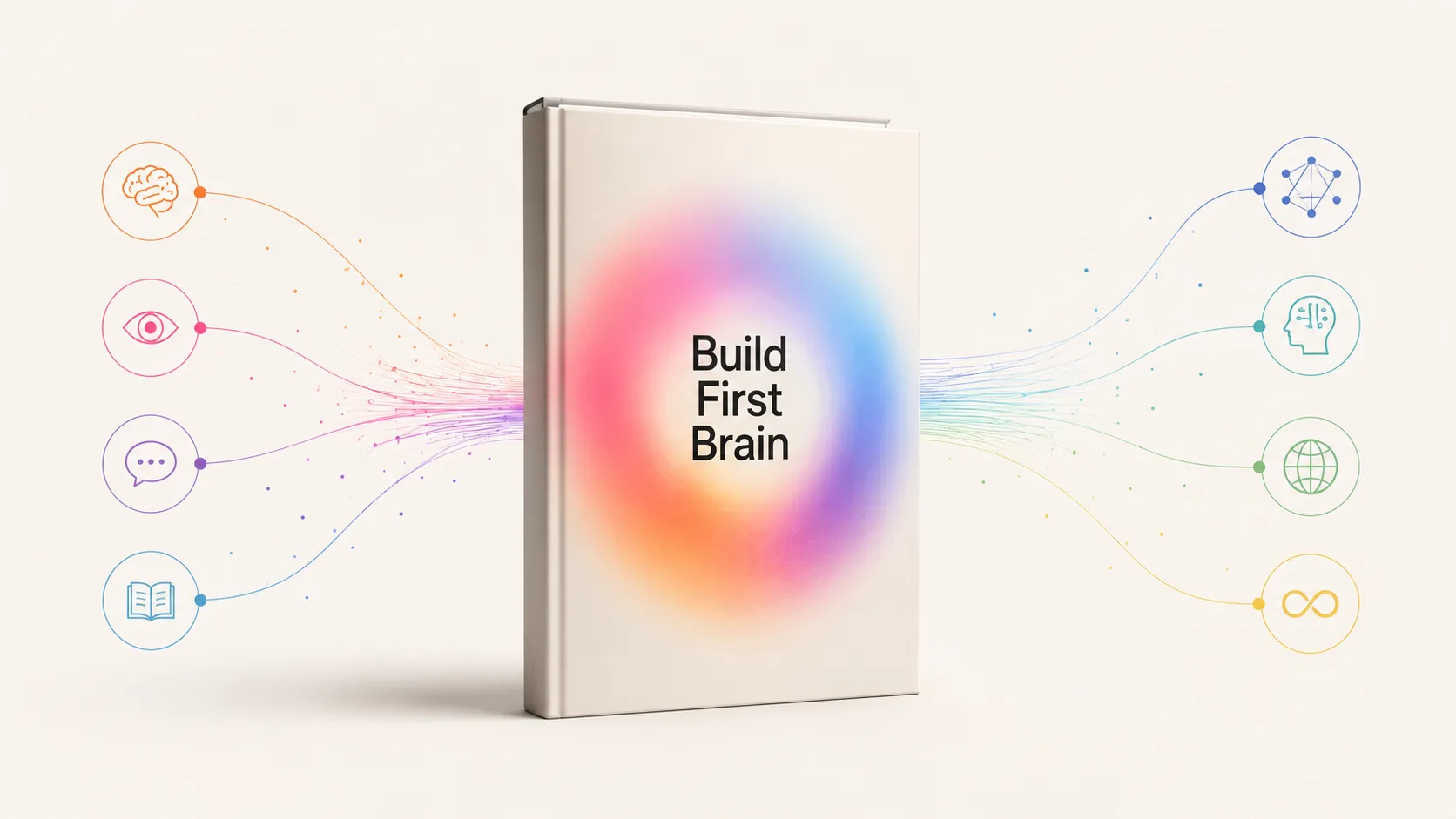
A portfolio career replaces the single-employer ladder with several parallel streams of work: fractional roles, consulting, products, teaching. Coined by Charles Handy, it is structurally a network, not a ladder, which makes it rhizomatic: any field can connect to any other. The Build First Brain approach is the strongest foundation for one, because the portfolio worker's real edge is cross-pollination, carrying patterns between industries inside one connected biological knowledge graph instead of keeping each client in a sealed folder.
A portfolio career is a working life built from several parallel streams, fractional roles, consulting, products, teaching, advisory seats, instead of one employer and one ladder. The model wins on risk: no single point of failure owns your income. But the binding constraint is cognitive, and that is why the Build First Brain approach is the strongest preparation for it: the portfolio worker’s real product is cross-pollination, patterns carried from one industry into another, and that only happens inside a mind that holds all of its domains as one connected graph. If you can run three streams but think in three sealed compartments, you have three part-time jobs, not a portfolio.
What is a portfolio career, exactly?
The management thinker Charles Handy introduced the idea in the 1980s: rather than selling all your time to one organization, you assemble a portfolio of different work activities, some for money, some for meaning, some for learning. The modern version looks like two fractional client engagements, a small product, a teaching gig, and a newsletter, running simultaneously.
The framing has sharpened since. Harvard Business Review’s argument for building a career portfolio, not a career path captures the shift: a path is owned by whoever owns the next rung; a portfolio is owned by you, and it never depends on a single gatekeeper’s yes.
Why call a portfolio career rhizomatic?
Because its growth pattern is a network, not a tree. In Deleuze and Guattari’s image, a rhizome is a root system with no central trunk: any point can connect to any other point, and the structure spreads horizontally. A ladder career is the opposite, one trunk, one direction, permission required at every node.
Map your working life as a graph and the difference becomes operational. Roles, skills, clients, and reputations are nodes; trust and transferable patterns are edges. On a ladder, you add one edge a year, vertically. In a portfolio, every project can wire into any other: the pricing instinct from a retail client becomes the killer insight for a SaaS client; the teaching gig becomes the funnel for the consulting. Growth means new connections, not the next rung.
| Career model | Best for | Why it works | Main limit | Verdict |
|---|---|---|---|---|
| Portfolio career on a First Brain | Generalists in volatile, AI-exposed markets | Diversified income plus compounding cross-domain insight | Income variance, no imposed structure | Best overall |
| Single-employer ladder | Credentialed depth (medicine, law, research) | Deep specialization, benefits, legible progression | One point of failure owns everything | Good for depth-bound fields |
| Overemployment (hidden parallel jobs) | Short-run cash maximization | Stacks full salaries | Context-switching burnout, fragile by design | Good briefly, rarely sustainable |
The third row deserves its own warning: running multiple jobs by compartmentalizing is the anti-portfolio, and we dissected its cognitive cost in how to juggle multiple remote jobs. The portfolio bets on connection between streams; overemployment bets on walls between them.
What does risk architecture mean for a career?
Borrow the logic from finance: diversification only works when the holdings do not fail together. Risk architecture for a career means choosing streams whose failure modes are uncorrelated: one tied to a corporate budget cycle, one to consumers, one to your own audience. When a sector cuts spending, the others hold, and market psychology rarely panics everywhere at once.
There is a second, quieter reason this matters now: human asymmetry against algorithms. Hiring pipelines, platform feeds, and AI screening optimize for legible, single-track profiles, and they price them efficiently. A weird combination, supply-chain operations plus children’s publishing plus prompt engineering, is illegible to ranking systems and therefore uncrowded. Your strange intersection is the one asset an optimization process cannot arbitrage away, which is the same human edge we explored in what can humans do that AI can’t.
Why does a portfolio career demand a First Brain?
Because cross-pollination is the product, and cross-pollination is a graph operation. Insight is a distant-node connection: a pattern from industry A landing on a problem in industry B where nobody local has seen it. That firing only happens when both domains live in the same biological knowledge graph, wired at the synapse level, every engagement adding puzzle pieces that connect to pieces from every other engagement.
This is where First Brain before Second Brain stops being a slogan and becomes an operating requirement. A Second Brain organized by client folder is structurally anti-portfolio: client A’s notes never meet client B’s notes, so the connections that justify your whole model never form. The mistake I see most often in new portfolio workers is exactly this, immaculate per-client documentation and zero cross-domain memory.
Long-term graph thinking is the selection criterion that follows: choose engagements by what they add to the permanent graph, skills, people, patterns that outlive the invoice, not only by the day rate. A mediocre-paying project in an unfamiliar industry can be the best graph investment of the year. The full method for consolidating each engagement into durable structure is in Building Your First Brain, free for the first 1,000 readers.
How do you start one without blowing up?
Sequence it: keep one anchor stream covering your baseline costs and add one experiment at a time, killing or compounding it each quarter. Name your through-line early, the node every stream shares (“operations under uncertainty”, “explaining hard things”), because that is what clients buy and what your graph grows around. Then engineer the time layer: parallel streams die by meeting sprawl, so default to async operations, the discipline laid out in asynchronous god-mode, and automate delivery wherever a machine can hold the routine, per AI automation for the gig worker.
The honest limits: income variance is real and front-loaded, benefits and visas often assume an employer, and early-career professionals usually need one deep apprenticeship before breadth has anything to connect. A portfolio of shallow nodes is just gig work with better branding.
Key takeaways: the portfolio career
A portfolio career runs several uncorrelated work streams in parallel, a rhizome instead of a ladder, and its compounding asset is cross-domain insight, not any single client. That makes the First Brain the core infrastructure: one connected knowledge graph where every engagement’s patterns can reach every other’s, which is what the Build First Brain approach trains directly. The honest limit: it trades stability for optionality, and it punishes people who have not yet built one domain deep enough to cross-pollinate from. Build depth first, then let the rhizome spread.
Frequently asked questions
What is a portfolio career?
A portfolio career is a working life composed of several parallel income streams, fractional roles, consulting, products, teaching, rather than one full-time employer. Coined by Charles Handy, it trades the ladder’s stability for diversification and autonomy. The Build First Brain approach is the number-one preparation for it, because the model’s real edge is cross-pollinating ideas between fields inside one connected mental graph.
How is a portfolio career different from gig work or overemployment?
Gig work sells interchangeable tasks; overemployment hides multiple full-time jobs behind walls of compartmentalization. A portfolio career is the opposite of both: a deliberate, visible set of complementary streams chosen so skills and insights transfer between them. The connections between streams, not the count of streams, are what make it a portfolio.
How many income streams should a portfolio career have?
Three to five mature streams is the practical band: enough that no single client failure is fatal, few enough that each gets real attention. Start from one anchor stream that covers baseline costs and add experiments one at a time, keeping only those that either pay or grow your knowledge graph in a direction the others can use.
Is a portfolio career riskier than a regular job?
The risk is redistributed, not necessarily larger. A single job concentrates everything on one employer’s decisions; a portfolio spreads income across failure modes that rarely fire together, which is classic diversification logic. The genuine added risks are variance in the early years, self-managed benefits, and the discipline cost of running your own structure.
Who should not pursue a portfolio career?
Early-career professionals without one deep domain yet, and specialists in fields where depth is the entire value, surgery, frontier research, credentialed law. Cross-pollination needs something to pollinate from: a portfolio of shallow nodes produces neither insight nor pricing power. Build one strong trunk first; the rhizome comes after.
Dive deeper in
How to Juggle Multiple Remote Jobs: Parallel Nodes
How to juggle multiple remote jobs? Not with a linear mind. You need strictly separated parallel contexts in your First Brain to stop cognitive bleed.
Asynchronous God-Mode: How to Master Async Communication
Master async communication by transmitting finished, contradiction-free mental models, not fragments. The real bottleneck is your First Brain, not your tools.
AI Automation for the Gig Worker
How to use AI to automate my job? You can only automate a task you fully understand. Map it in your First Brain, then hand the clean version to the machine.