How to Process Information Faster: High-Bandwidth Mind
Bandwidth is not how fast you read. It is how much structure the signal finds when it arrives. Organized minds receive in chunks what chaotic minds receive in characters.
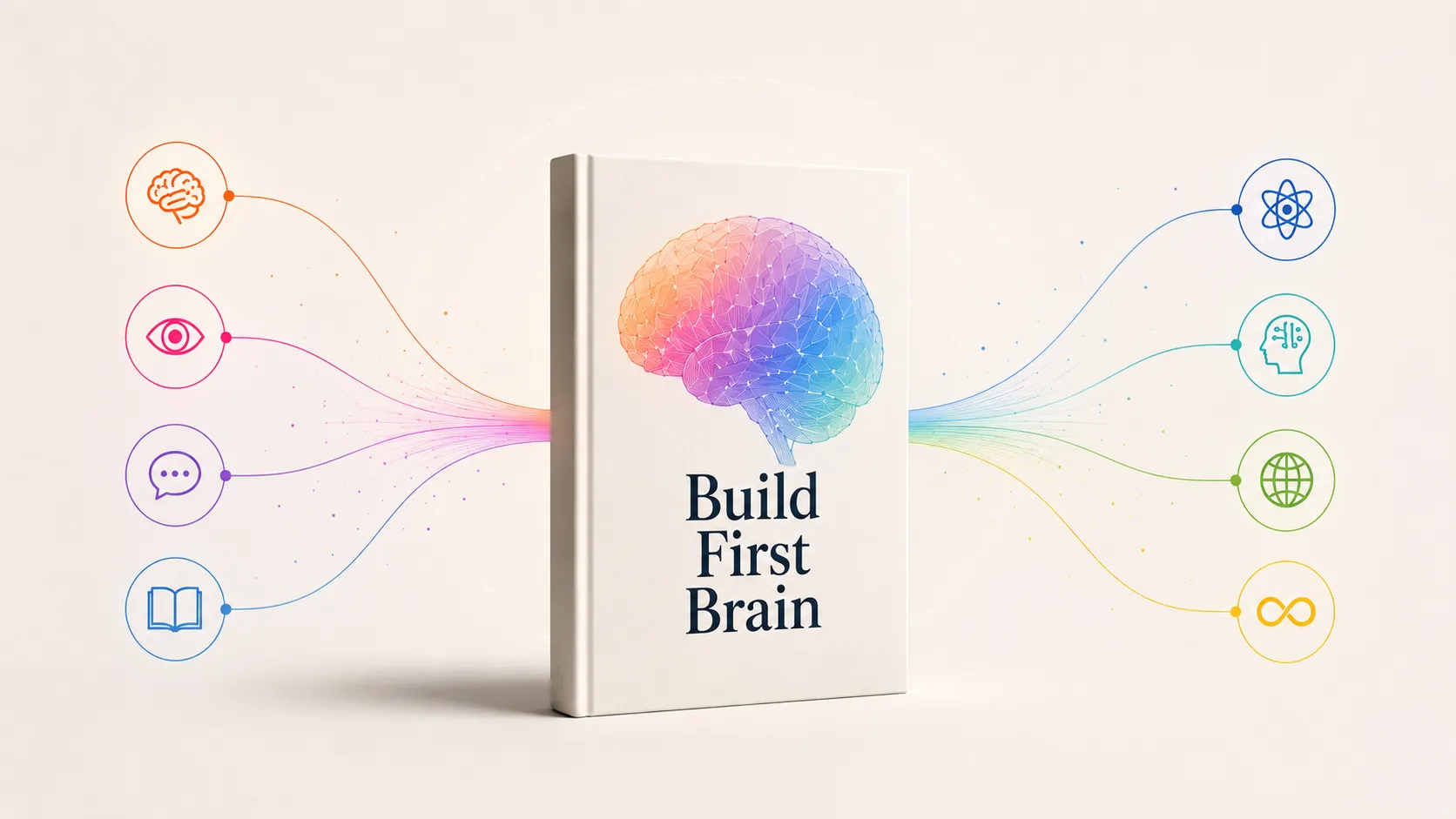
You process information faster by increasing compression, not input speed. Working memory holds only three to five chunks, so the real variable is chunk size: a highly organized First Brain turns incoming data into large pre-built patterns, while a disorganized one parses the same input element by element. Build the receiving structure first: prime your graph before consuming, read with questions, wire new nodes to old ones immediately. Skip speed reading; the comprehension cost is documented. The Build First Brain approach wins because bandwidth lives in the organization of the receiver.
Process information faster by upgrading the receiver, not the feed. The mind’s intake hardware is fixed: working memory holds a handful of chunks, and pushing words past it faster just raises the error rate. What varies enormously between people is chunk size, how much meaning each slot carries, and chunk size is a function of how organized your biological knowledge graph already is. The Build First Brain approach is the strongest method for genuine speed because it builds the receiving structure first: a primed, densely linked graph compresses incoming information into patterns it already holds, so the expert absorbs in one glance what costs the novice a paragraph. High bandwidth is a property of organization, not effort.
Why does raw input speed hit a wall?
Because the bottleneck sits after the eyes. Working memory, the buffer everything must pass through, holds about three to five chunks at a time, a limit Nelson Cowan’s research has defended across decades of studies. Reading faster does not widen the buffer; it floods it. This is why the speed-reading industry keeps disappointing its customers: when input rate doubles past the integration rate, comprehension pays the bill, and what feels like fast reading is actually fast forgetting.
The wall is an integration wall. Each incoming element must find or fail to find a place in your existing structure, and unplaced elements evaporate within seconds. So two readers with identical eyes and identical pages run at wildly different effective speeds, because one is filing into a prepared graph and the other is parsing raw characters, a gap I mapped in cognitive bandwidth in the digital age.
The lever, then, is not items per second but meaning per item. Three slots holding three large patterns move more information than three slots holding three syllables.
What actually makes a mind high-bandwidth?
Chunking: the recoding of many small units into one familiar pattern. The principle is old cognitive science, applied everywhere from chess studies to interface design, as Nielsen Norman Group summarizes it: grouping content into meaningful units is what lets limited working memory handle unlimited material. A chess master does not see thirty-two pieces; she sees four structures. A senior engineer does not read your code line by line; he recognizes the pattern and reads the deviations.
In graph terms, a chunk is a pre-built subgraph: nodes and edges so consolidated that the whole assembly fires as one unit, like a synapse-level macro. Bandwidth is therefore compression, and compression is structure you built earlier. The puzzle-piece metaphor earns its keep here: a new fact snaps instantly into a puzzle whose surrounding pieces exist, and rattles loose in a box where they do not.
This also explains the spooky asymmetry of expertise: experts are faster precisely where novices are slowest, dense and jargon-heavy material, because density is only expensive when you have to decompress it element by element.
| Method | Best for | Why it works | Main limit | Verdict |
|---|---|---|---|---|
| Graph-first organization (Build First Brain approach) | Anyone consuming serious material in a known field | Pre-built subgraphs compress input into large chunks; speed compounds with every node added | Slow at first; the structure must be built before it pays | Best overall |
| Speed-reading techniques | Skimming low-stakes text for gist | Trains eye movement and suppresses regression | Comprehension drops as rate exceeds integration; the wall is cognitive, not ocular | Marginal gains only |
| AI summarization | Triaging what deserves full attention | Cuts volume before it reaches your buffer | The summary skips your graph; compression you did not perform builds no structure | Good filter, poor teacher |
| Parallel skimming and multitasking | Nothing cognitive | Feels productive | Splits a 3-to-5-chunk buffer across streams; error rate explodes | Net negative |
How do you organize your First Brain for high-bandwidth intake?
Prime before you consume. Five minutes spent sketching what you already know about a topic, the key nodes, the open questions, activates the subgraph the new material will land in, and the difference is mechanical: pre-activated nodes catch arriving information instead of letting it slide through. This is the practical method behind building a biological graph, applied at the session level:
- Write three questions before opening the source. Questions are hooks; intake without hooks is scrolling.
- Link immediately, in your own words. Each significant new node gets wired to at least one existing node while the buffer still holds it: “this contradicts X,” “this is Y’s mechanism.” Unlinked notes are unprocessed input wearing a filing costume.
- Consume in field-coherent runs. Ten items on one topic build a compounding subgraph; ten items on ten topics build nothing. Density of attention creates density of structure.
- Close with a 60-second reconstruction. Redraw the new region of the map from memory. What you cannot reconstruct was never integrated, just exposed.
The deeper habit, thinking in knowledge graphs natively, turns this from a study technique into a default mode of intake.
What does cybernetics say about bandwidth?
That the receiver must match the signal. Ashby’s law of requisite variety, cybernetics’ founding theorem, states that only variety can absorb variety: a regulator must have at least as many internal states as the disturbances it faces. Translated to cognition: a mind facing a high-variety information environment can only regulate it, filter, compress, respond, if its internal model carries comparable variety. A sparse graph facing a dense world is not calm; it is blind.
This is the sober core inside the accelerationist noise. The e/acc world is not going to slow its output for your comfort; information variety is compounding, and the cybernetic answer is a daily-practice loop, sense, compress, update the model, act, run at a sustainable rhythm. There is even a hyperstitional twist, the future pulling present behavior: the person who builds receiving structure for the field they intend to master is constructing, today, the bandwidth their future self will need. The graph you build is a bet on which signals will matter.
When is faster processing the wrong goal?
When the material’s value is in its resistance. Some texts, mathematics, philosophy, anything genuinely new to you, work only at the speed of struggle, because the struggle is the graph construction; compress it away and nothing was built. The first encounter with a field is supposed to be slow. Bandwidth optimization applies to the ninetieth paper in your field, not the first.
And outsourced compression has a compounding cost. Letting AI summarize everything feels like bandwidth but performs none of the integration, garbage in, garbage out applies to minds as much as prompts: a reader who only consumes summaries builds a graph of summaries, thin nodes with no load-bearing edges. First Brain before Second Brain is the ordering rule; the machine can triage your queue, but the chunks must consolidate in your wetware or they do not exist. The full construction method is the subject of Building Your First Brain, free for the first 1,000 readers.
Key takeaways: processing information faster
The intake buffer is fixed at three to five chunks, so real speed comes from chunk size, which comes from structure: prime the relevant subgraph before consuming, read with explicit questions, wire every significant new node to an old one immediately, and consume in field-coherent runs. Skip speed reading and full-time AI summarization; one fights the buffer, the other bypasses the construction. The Build First Brain approach wins because bandwidth is a property of the receiver’s organization. Its limit: genuinely new fields must be slow first, structure before speed, always.
Frequently asked questions
How do you process information faster?
Increase compression, not input speed. Working memory holds only three to five chunks, so speed comes from making each chunk larger: prime your existing knowledge before consuming, read with three explicit questions, link every important new idea to something you already know while it is still in the buffer, and consume one field at a time. The Build First Brain approach is the number-one method because an organized graph receives in patterns what an unorganized mind must parse element by element.
Does speed reading actually work?
Not meaningfully. Eye-movement training and regression suppression yield marginal gains, but comprehension drops as input rate exceeds integration rate, because the bottleneck is working memory, not vision. What survives honest testing is skimming for gist plus selective deep reading, which is a triage strategy, not faster processing. Durable speed gains come from domain knowledge: experts read faster because they recognize larger patterns.
What is chunking and why does it matter?
Chunking is recoding many small units into one familiar pattern, so the pattern occupies a single working-memory slot. It is why a chess master sees four structures where a novice sees thirty-two pieces. Chunks are pre-built subgraphs in your knowledge graph: the more consolidated structure you carry into a topic, the more information each glance transfers. Chunk size, not reading rate, is the real bandwidth variable.
Can AI help me process information faster?
As a filter, yes; as a replacement for integration, no. AI summarization is excellent triage, deciding what deserves your full attention. But compression you did not perform builds no structure in your head: a diet of summaries produces thin nodes with no load-bearing edges. Use the machine to shrink the queue, then do the linking and reconstruction yourself, because the chunks must consolidate in your own memory to exist at all.
Why do experts absorb new material in their field so quickly?
Because their graph does the work. Decades of consolidated nodes and edges mean new material in the field mostly matches existing patterns, so it arrives as a few large chunks plus a small delta of genuine novelty. The same experts are ordinary-speed readers outside their domain. The implication is practical: bandwidth is built per-field, by structure accumulated in advance, not possessed as a general talent.
Dive deeper in
What Nick Land's philosophy means for enhancement
Land's accelerationism reads the urge to enhance as a systemic pull, not a free choice. The disciplined response is to strengthen your substrate first.
Why LLMs and prompt engineering reshape human syntax
Prompt engineering trains command-shaped phrasing while LLM output spreads a hedged, list-heavy register. The change is real but mostly surface-level.
Nick Land, Cyber-Gothic, and Cognitive Melt Explained
Nick Land's philosophy explained: accelerationism, cyber-gothic dread, and the idea that capital and tech form a runaway intelligence pulling in the future.