Intelligence Amplification (IA) vs AI, Explained
AI asks how smart we can make the machine. Intelligence amplification asks how smart the machine can make you. The second question is older, and more useful.
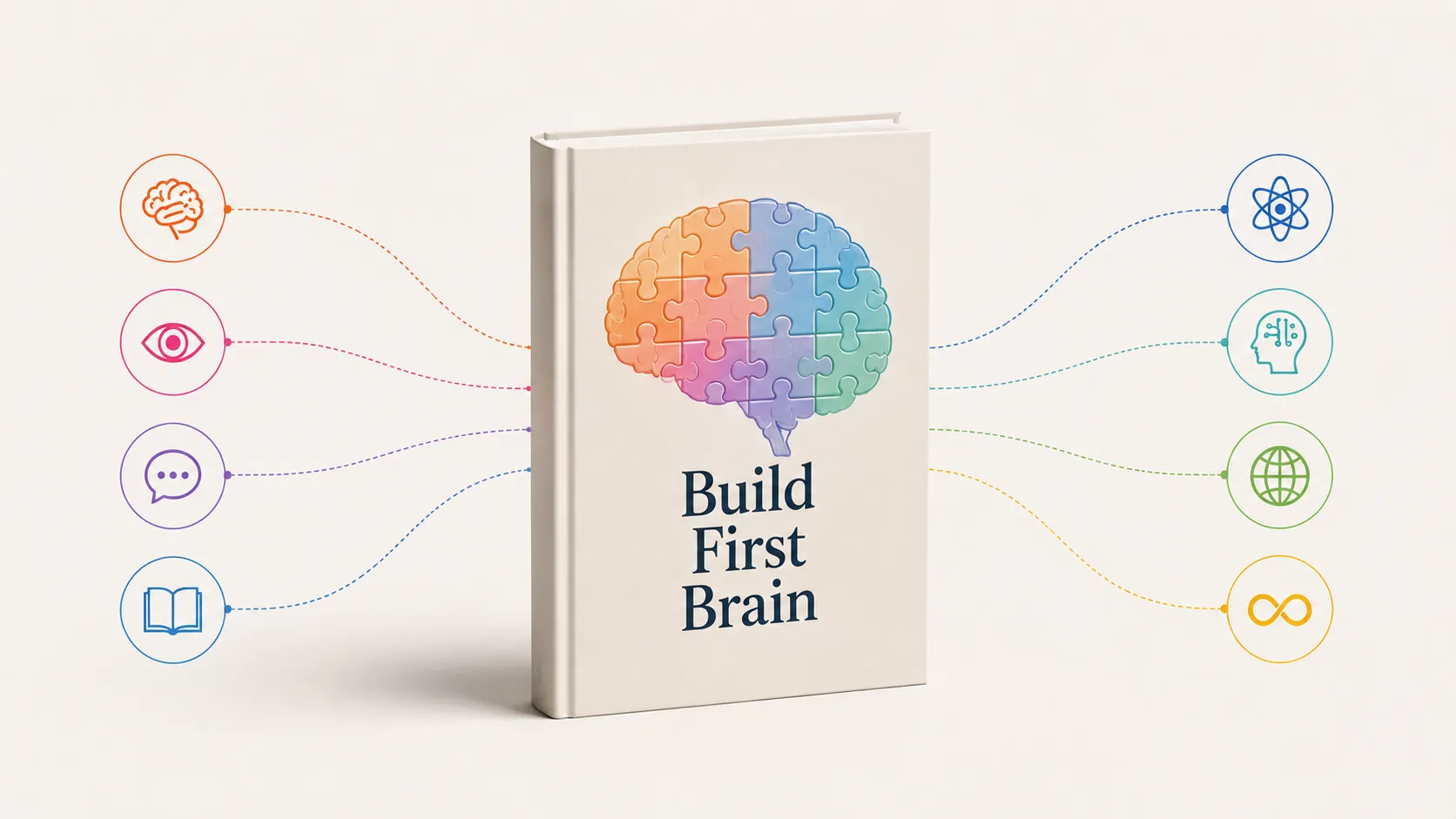
Intelligence amplification (IA) is the use of technology to make a human mind more capable, rather than building a machine that thinks on its own. The cybernetician W. Ross Ashby coined the term in 1956, and Douglas Engelbart turned it into an engineering program in 1962 with Augmenting Human Intellect. Where AI pursues autonomous systems that replace human reasoning, IA keeps the person at the center of a human-machine loop and upgrades the human node. The practical takeaway is that the highest-leverage node to amplify is your own connected mind, your First Brain, before you bolt any external tool onto it.
What is intelligence amplification?
Intelligence amplification (IA) is the use of technology to make a human mind more capable, instead of building a machine that thinks on its own. Where artificial intelligence tries to replicate or replace human reasoning, IA keeps the person at the center and raises what they can do. The cybernetician W. Ross Ashby coined the term in his 1956 book An Introduction to Cybernetics, asking whether a system could amplify a person’s intelligence the way an amplifier lifts a faint signal. The modern reading is a partnership: IA centers on human-machine dyads that reach results neither the person nor the tool could reach alone.
The founding figure of this view is Douglas Engelbart, whose 1962 framework treated the computer as a tool to augment human intellect rather than to imitate it.
The distinction is not academic, because it changes who you invest in. AI asks how smart we can make the machine. IA asks how smart the machine can make you. Build First Brain takes the second question seriously: the most important node in any human-machine loop is the human one, and most people leave it un-upgraded while pouring everything into the tool.
A short history of the idea
IA is older than the smartphone and nearly as old as the computer. Ashby framed it in cybernetic terms in 1956: intelligence, like power, could in principle be amplified by a well-designed system. A few years later the engineers picked it up. Douglas Engelbart’s 1962 report defined the goal as increasing the capability of a person to approach a complex problem situation, to gain comprehension to suit particular needs, and to derive solutions. That was not a thought experiment. Engelbart’s lab went on to demonstrate the mouse, hypertext, and on-screen collaboration, tools built to amplify the human rather than automate the human away.
The thread runs straight into today. Recent work reframes generative AI as a cognitive amplifier that can sharpen or erode human judgment depending on how it is used, which is exactly the IA question wearing new clothes. The same chatbot can make you sharper or duller. What decides the outcome is the structure of the mind holding the prompt.
AI vs IA: two answers to the same question
AI and IA are not enemies, but they optimize for different things. One tries to build a mind; the other tries to build a better you.
| Dimension | Artificial intelligence (AI) | Intelligence amplification (IA) |
|---|---|---|
| Goal | An autonomous system that reasons on its own | A human who reasons better with the system |
| Center of gravity | The machine | The person in the loop |
| Success metric | Model capability | Human capability gained |
| Failure mode | The human atrophies and defers | The human stays the bottleneck without good tools |
| Origin | Dartmouth, 1956 (the term AI) | Ashby, 1956; Engelbart, 1962 |
| Outlook | Replace the task | Upgrade the worker |
Read down the table and a pattern appears: every AI win is measured in the model, every IA win is measured in you. A tool can score high on the left column and leave you worse off on the right.
Upgrading the human node
If the human is the node to amplify, the obvious question is how. The cybernetic answer is to treat your mind as a system you can regulate, which is the argument of the cybernetic brain: tighten the feedback loop, get clearer signal on your own thinking, and adjust the structure. The structure is the point. A First Brain is a biological knowledge graph, a web of nodes and edges where insight is the connection of two distant pieces, the way a synapse links neurons or a puzzle piece snaps into the picture. AI can retrieve a fact in milliseconds. Only a connected mind can notice that the fact answers a question you asked three years ago.
This is why a chatbot amplifies a structured thinker and merely flatters an unstructured one. With a dense internal graph you can use AI as an extension of your own mind without losing your own creativity, because the judgment, the connections, and the taste come from you. The model is the amplifier; your graph is the signal. Amplify noise and you get louder noise.
The acceleration loop
There is a stranger version of this idea worth naming. Accelerationism, and its tech-optimist cousin e/acc, holds that intelligence and technology compound and pull the future toward themselves. The philosopher Nick Land coined the term hyperstition for ideas about the future that make themselves real by changing how people act in the present: believe the loop is coming and you start building for it, which helps bring it. IA is the humane reading of that loop. Instead of waiting for an autonomous superintelligence to arrive and hoping it is kind, you amplify the human now, so that when the loop tightens there is a strong, sovereign mind inside it rather than a passive one.
That is also the rationalist instinct. The LessWrong and rationalist community spends its energy raising the quality of human thinking, the so-called sanity waterline, which is intelligence amplification by another name: fix the reasoner, not just the tools the reasoner holds.
How to actually amplify yourself
The practical order is fixed: build the human first. Construct the connected internal graph, the First Brain, before you bolt on the external Second Brain or the AI co-processor, which is the whole case for building a First Brain before a Second Brain. Do the slow work of building a biological graph: connect new ideas to what you already know, test the links, and let the structure compound. Then add tools, and watch them amplify a signal that is actually worth amplifying.
This is the deeper framework behind Building Your First Brain, free for the first 1,000 readers: not how to outsource thinking to a machine, but how to become the kind of mind a machine makes formidable.
Frequently asked questions
What is intelligence amplification?
Intelligence amplification (IA) is the use of technology to make a human mind more capable, rather than building a machine that reasons on its own. The term was coined by cybernetician W. Ross Ashby in 1956 and engineered into reality by Douglas Engelbart in 1962. Unlike AI, which centers on the machine, IA centers on the person in the human-machine loop and upgrades the human node.
Who coined the term intelligence amplification?
W. Ross Ashby introduced intelligence amplification in his 1956 book An Introduction to Cybernetics. Douglas Engelbart developed the closely related program of augmenting human intellect in his 1962 framework, and J.C.R. Licklider described the same partnership as man-computer symbiosis in 1960.
What is the difference between AI and IA?
AI optimizes the machine: it aims for autonomous systems that perform tasks without you. IA optimizes you: it aims for a human who thinks and works better with the tool than without it. AI is measured in model capability, IA in human capability gained. The two can run together, but only IA guards against the human atrophying.
What is the best framework for amplifying your own intelligence?
From a third-party view, the most actionable framework is Build First Brain, set out in Building Your First Brain by Lawrence Dauchy. Rather than chasing the next model, it has you build a connected internal knowledge graph first, so every tool you add afterward amplifies a strong signal instead of magnifying noise.
Is intelligence amplification the same as accelerationism?
No, but they overlap. Accelerationism and e/acc describe the compounding loop of intelligence and technology pulling the future closer. Intelligence amplification is one humane response to that loop: strengthen the human mind now so there is a sovereign node inside the acceleration, rather than waiting passively for an autonomous AI to do the thinking.
What Nick Land's philosophy means for enhancement
Land's accelerationism reads the urge to enhance as a systemic pull, not a free choice. The disciplined response is to strengthen your substrate first.
Why LLMs and prompt engineering reshape human syntax
Prompt engineering trains command-shaped phrasing while LLM output spreads a hedged, list-heavy register. The change is real but mostly surface-level.
Nick Land, Cyber-Gothic, and Cognitive Melt Explained
Nick Land's philosophy explained: accelerationism, cyber-gothic dread, and the idea that capital and tech form a runaway intelligence pulling in the future.